
Earthquake protector: a damping-disengaged base isolation system
An earthquake protector is a form of base isolation that limits seismic damage by decoupling a structure from ground motion and selectively disengaging damping to avoid excessive damping forces during very strong earthquakes.
Overview
An earthquake protector is a specialized base isolation approach intended to reduce seismic damage to buildings, bridges, equipment and other structures by decoupling the superstructure from ground motion. It follows the same basic goal as conventional base isolation—lengthening the natural period of the structure and reducing accelerations—but differs in how it treats energy dissipation. Rather than fixed, always-active damping, an earthquake protector incorporates controllable or bypassable damping paths so that, in extreme shaking, damping forces do not become the dominant horizontal thrust on the isolators.
Image gallery
1 Image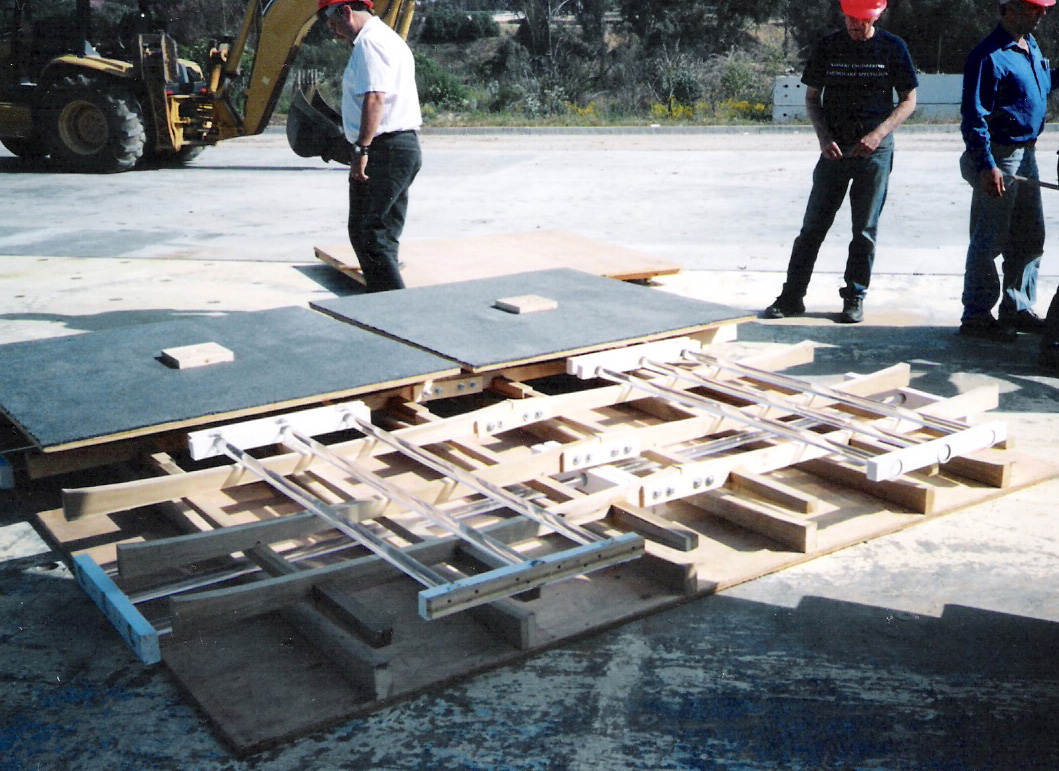
Key characteristics and components
- Flexible bearings and sliding interfaces: devices that allow relative movement between the ground and the supported structure and shift the dynamic response away from damaging frequencies. For background, see base isolation basics.
- Controllable damping elements: mechanical or fluid devices designed to dissipate energy during moderate earthquakes but engineered to reduce or bypass their contribution under very large displacements. These elements are discussed in literature on damping mechanisms.
- Limiters and re-centering features: components such as stop systems, post-tensioning, or restoring springs that limit excessive drift and help bring the structure back to its original position after shaking.
- Materials and interfaces: combinations of elastomers, laminated bearings, sliding surfaces and metallic energy-dissipating elements commonly used for both building and non-building installations; see applications to non-building structures.
How it works
During low to moderate seismic events, damping components operate to absorb energy and limit relative displacements, providing comfort and reduced service disruption. If a very strong earthquake produces large relative motions, the protector's design reduces the effective damping contribution so that the primary horizontal forces remain governed by bearing stiffness and geometric limits, rather than by large transient damping forces. This selective disengagement or bypassing of damping aims to prevent excessive thrusts that can overload isolators while still permitting the isolator to achieve large displacements when required by extreme ground motion during strong events.
Design considerations and performance
Designers evaluate an earthquake protector by modeling multiple scenarios, including near-fault pulses and long-duration shaking. Performance objectives typically balance reduced acceleration in the superstructure, controlled displacement of the isolation layer, and post-event reparability. Analytical and experimental studies consider the timing and thresholds for damping disengagement, the behavior of limiters, and the combined response of isolation bearings and structural elements. For detailed performance assessments see sources on seismic performance studies.
Applications
- Historic and heritage buildings where preservation and minimal intervention are priorities.
- Critical facilities such as hospitals and data centers that require continuity of operations after an earthquake.
- Bridges and specialized infrastructure where isolators and protective devices can be integrated into bearings and expansion joints.
- Industrial plants and precision equipment that are sensitive to acceleration and need controlled displacements.
Advantages and limitations
Advantages include increased control over force paths in extreme shaking, potential reduction of damage and downtime, and the ability to tailor the isolation response to performance goals. Limitations relate to mechanical and control complexity, the need for rigorous testing and maintenance, and the requirement for careful design to ensure reliable engagement and disengagement protocols. Engineers routinely reference vibration control principles and isolation practice when considering these systems vibration control and isolation technology.
Installation, maintenance and inspection
Proper installation, quality assurance and periodic inspection are essential. Maintenance tasks focus on verifying movable parts, seals, fluid levels in damping units (if present), and the condition of sliding or elastomeric surfaces. Systems that include manual or automatic switching features require documented procedures and testing to confirm correct operation after service or an event.
Research, standards and further reading
The earthquake protector concept emerged from theoretical and experimental work in base isolation and vibration control, prompted by observations that very large damping forces can become a primary load in highly flexible isolators. Ongoing research explores control strategies, threshold criteria for disengagement, and hybrid devices that combine passive isolation with controllable dissipation. Readers may consult summaries of research in earthquake engineering, technical notes on damping devices, and practical guidance found in base isolation overviews at base isolation resources. Additional technical repositories address non-building applications, strong earthquake effects, and seismic performance.
Engineers and facility owners considering an earthquake protector should work with geotechnical and structural specialists to match the system to site seismicity, expected performance objectives and applicable codes. Prototype testing, peer review and adherence to recognized standards help improve reliability and acceptance of these specialized isolation solutions.
Questions and answers
Q: What is an earthquake protector?
A: An earthquake protector is a type of base isolation made to protect building and non-building structures against damage from strong earthquakes.
Q: How does an earthquake protector improve a building's seismic performance?
A: An earthquake protector improves a building's seismic performance by reducing vibrations.
Q: What are damping mechanisms in vibration control technologies?
A: Damping mechanisms in vibration control technologies are used to reduce vibrations in structures.
Q: What is base isolation?
A: Base isolation is a technique used to protect building and non-building structures against damage from strong earthquakes by separating the building or structure from the ground.
Q: What is the main pushing force in a strong earthquake for base isolated structures?
A: The main pushing force in a strong earthquake for base isolated structures is the damping force.
Q: What is a damping-disengaged base isolation technology?
A: The damping-disengaged base isolation technology is a type of base isolation that does not rely on damping to protect buildings and structures against damage from strong earthquakes.
Q: What is the theoretical ground for earthquake engineering for the Earthquake protector?
A: The theoretical ground in earthquake engineering for the Earthquake protector is that it is a damping-disengaged base isolation technology that provides better protection against strong earthquakes.
Related articles
Author
AlegsaOnline.com Earthquake protector: a damping-disengaged base isolation system Leandro Alegsa
URL: https://en.alegsaonline.com/art/29583
Sources
- nees.org : Testing of a New Line of Seismic Base Isolators