
E (the letter of the Latin alphabet)
E is the fifth letter of the Latin alphabet, a vowel in English with multiple pronunciations, an orthographic marker (silent ‘magic e’), and a symbol with many scientific, mathematical and cultural uses.
Overview
E is the fifth letter of the modern Latin (English) alphabet and one of its five primary vowel letters. As a written character it appears in both uppercase (E) and lowercase (e) forms and is ubiquitous across languages that use the Latin script. In English and many other languages, E represents several vowel sounds and plays a large role in spelling, pronunciation, and word formation. Its position as the fifth letter is often noted in alphabet lists: see the fifth position and general letter entries for context.
Image gallery
3 Images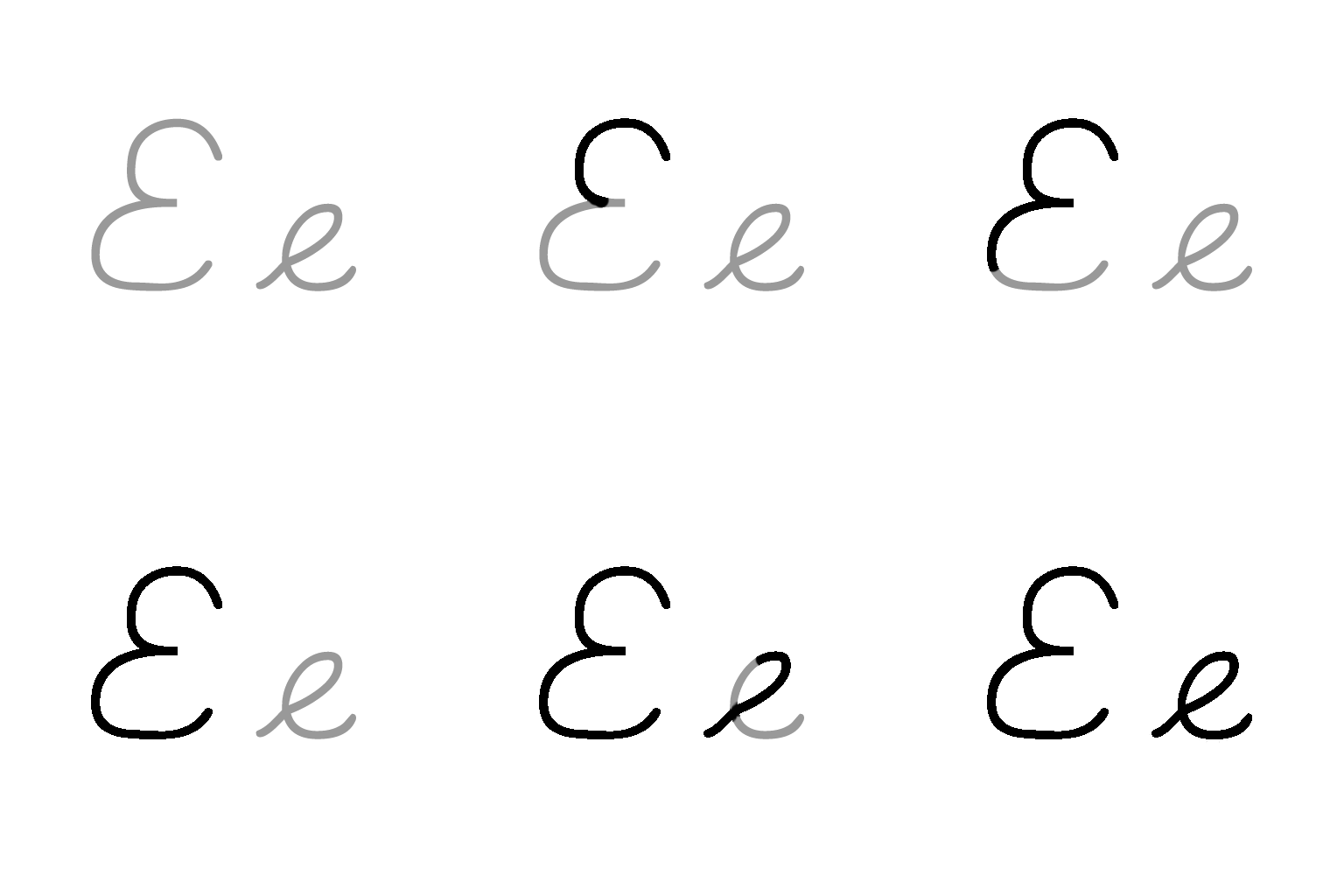


Pronunciation and phonetic roles
In English E can represent different phonemes. Two common patterns are the short vowel as in "pet" and the long vowel as in "see." In unstressed syllables it frequently reduces to a schwa (an unstressed "uh" sound). E also participates in digraphs and sequences that change its pronunciation — for example ea (as in "team" or "bread"), ee (as in "seen"), and ei (as in "ceiling"). For more on English usage, consult resources on the English vowel system.
Spelling patterns and the "silent e"
One of the most familiar orthographic roles of E is the so-called "magic e" or silent final e. When a word ends with an unpronounced e, it often causes a preceding vowel to be pronounced as a long vowel (compare rid and ride, hop and hope). Silent E also affects consonant pronunciation and helps mark syllable boundaries, morphological endings, or gender in some loanwords. English spelling conventions involving E are irregular but follow many recurring patterns learned by readers and writers.
History and origin
The letter E traces back to the Phoenician letter he (𐤄), which originally depicted a human figure or window and represented a glottal sound. Through adaptation into Greek as Epsilon (Ε, ε) and then into the Roman alphabet, its shape and phonetic value evolved into the modern E. This lineage is shared by many alphabetic systems derived from Greek and Latin, and variations appear in other scripts and type traditions.
Uses, symbols, and examples
- Mathematics: the lowercase e denotes the base of natural logarithms (a fundamental constant roughly equal to 2.71828).
- Science and technology: e can stand for the elementary charge in physics or an electron in chemistry and physics; in computing it appears in scientific notation (for example, 1.2E3 to indicate 1.2×10³).
- Abbreviations and grading: E is used in various grading systems, abbreviations, and as an initial letter in acronyms.
- Typography and diacritics: many languages modify E with accents (é, è, ê) to indicate distinct sounds or historical changes.
Notable facts and technical details
E is the most frequently used letter in English texts, which has consequences for cryptography, keyboard design, and word puzzles. In computing and character encoding the uppercase E is U+0045 and ASCII 69, while the lowercase e is U+0065 and ASCII 101. Its high frequency and varied phonetic roles make E central to spelling instruction, literacy research, and a wide range of symbolic functions across disciplines. For broader alphabetical information see an alphabet overview.
Related articles
Author
AlegsaOnline.com E (the letter of the Latin alphabet) Leandro Alegsa
URL: https://en.alegsaonline.com/art/29457