
Doomsday (comics)
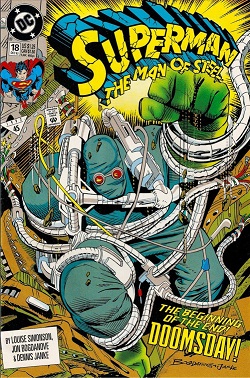
Doomsday is a powerful supervillain in DC Comics best known for killing Superman in the 1992 'Death of Superman' storyline. Created by Dan Jurgens, he is a near-unstoppable force with regenerative and adaptive abilities.
Overview
Doomsday is a fictional supervillain appearing in American comic books published by DC Comics. Introduced in 1992 and created by writer-artist Dan Jurgens, he was designed as a physical nemesis capable of matching Superman in raw power. Doomsday is widely remembered for his central role in the 1992 "Death of Superman" storyline, in which the character delivers a fatal blow to the Man of Steel. The figure has since become one of Superman's most iconic adversaries and a recurring antagonist across comics and other media.
Image gallery
5 Images


Creation and publication history
Dan Jurgens conceived Doomsday as a purely physical threat rather than a villain driven by ideology or cunning. His first partial and then full appearances occurred in 1992 during a period of frequent crossover events in the DC line. The character's brutal design and the dramatic narrative consequences of his clash with Superman made Doomsday an immediate focal point for readers and creators, prompting sequels, retellings, and return appearances in subsequent years. Critical and popular reception has been significant: for example, Doomsday ranked among notable comic book villains in several retrospective lists.
Fictional origin and nature
Within DC continuity, Doomsday is typically described as a creature engineered through extreme evolutionary and genetic processes on a harsh, prehistoric world. Different storylines and reboots have varied in the details, but a recurring element is that Doomsday repeatedly undergoes lethal encounters only to resurrect and emerge with immunity to whatever killed him before. This pattern produces a being that adapts rapidly, learns by surviving, and becomes progressively harder to stop. In many depictions he is nonverbal, driven by rage and an instinct to destroy rather than by reasoned motivation.
Characteristics and powers
- Immense physical strength comparable to Superman's, enabling titanic battles and destruction.
- Exceptional durability and resistance to conventional injury; survives extreme forces and trauma.
- Rapid regeneration and resurrection after apparent death, often with new resistances.
- Adaptive evolution: repeated defeats lead to immunity or countermeasures to the methods that harmed him before.
- Limited higher cognition and speech in most versions; acts primarily through instinct and violence.
Major storylines and adaptations
Doomsday's debut storyline culminated in the widely publicized clash that ended with Superman's death, a storyline that generated substantial media attention and long-term narrative consequences in the DC Universe. Since that event, the character has returned repeatedly in comics, often as a force that tests heroes physically and morally. Doomsday has also appeared in animation, video games, and live-action adaptations. A prominent modern portrayal appears in the 2016 film "Batman v Superman: Dawn of Justice," where the creature was realized using motion-capture performance and voice work credited to Robin Atkin Downes. He also features in several animated films and television projects that adapt or reinterpret his origin and capabilities.
Cultural impact and legacy
Doomsday functions as an archetype of the unstoppable monster in superhero fiction: a relentless embodiment of force that compels heroes to confront limits, sacrifice, and the cost of victory. The character's role in killing Superman made him a cultural touchstone in comic-book history and sparked debates about narrative stakes and the resurrection of iconic heroes. Doomsday continues to be used by writers as a means to stage large-scale conflicts and to explore themes of mortality, resilience, and the nature of power.
For readers seeking more detailed publication history, adaptations, or issue-by-issue appearances, consult official publisher resources and collected editions on the character. Additional background and credits for creators can be explored through dedicated comic databases and retrospective essays. See also general publisher information at publisher page and broader Superman context via Superman resources.
Author
AlegsaOnline.com Doomsday (comics) Leandro Alegsa
URL: https://en.alegsaonline.com/art/28509
Sources
- comics.ign.com : "Doomsday is number 46"