
Dominant (music): the fifth scale degree and its harmonic role
In tonal music, the dominant is the fifth scale degree and the chord built on it (V). It exerts a strong pull toward the tonic and appears in cadences, modulations, and harmonic progressions.
Overview
The dominant is the fifth degree of a diatonic scale and the harmonic function associated with that degree. In a major scale or a minor scale, the dominant note sits a perfect fifth above the tonic. The chord built on this degree is called the dominant chord and is commonly labeled with the roman numeral V. For example, in the key of C the dominant note is G and the basic dominant triad is G–B–D; the dominant key is G major, a fifth above C (key relations).
Image gallery
2 Images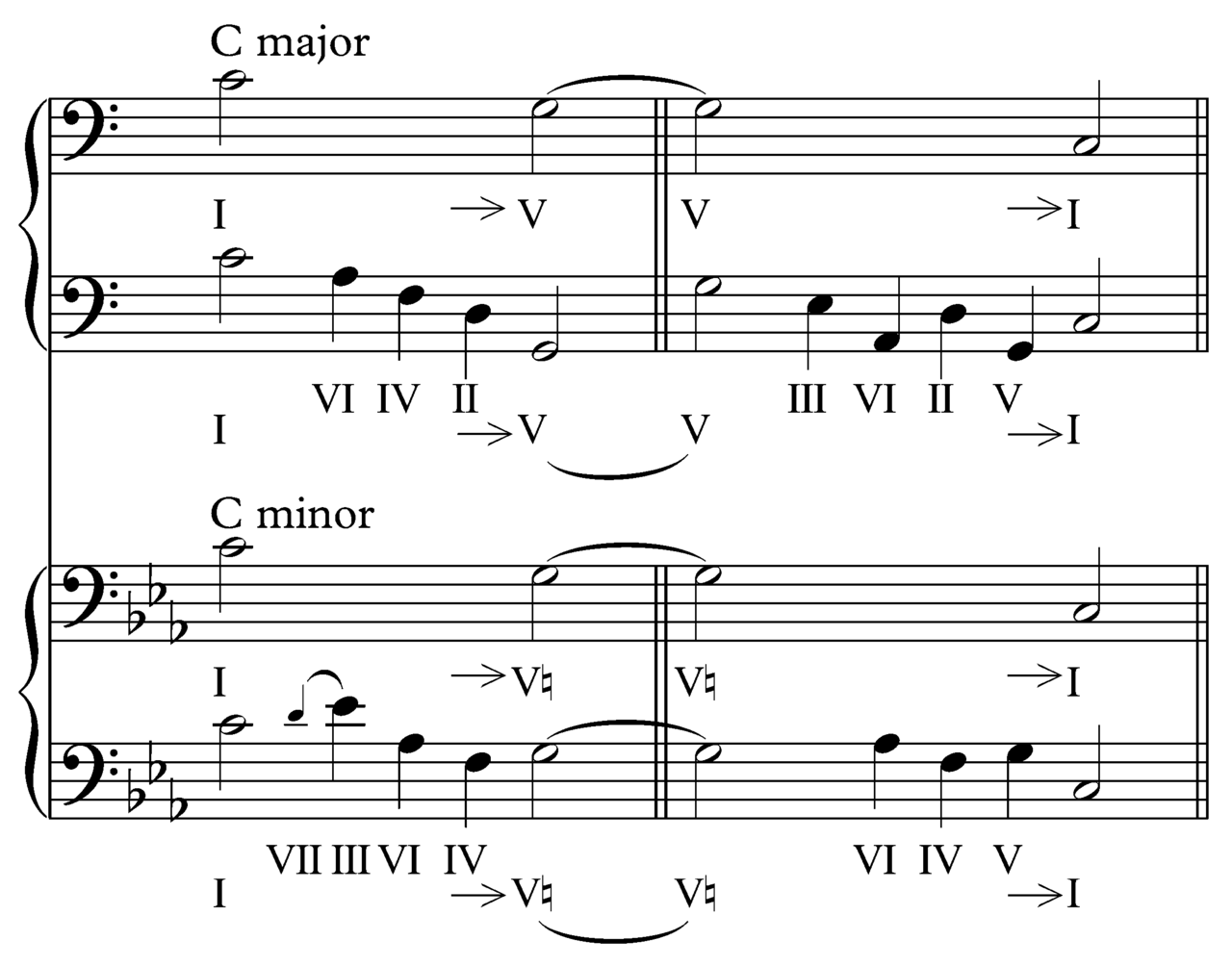

Function and voice-leading
The dominant has a strong tendency to resolve to the tonic (V→I), which is a defining feature of tonal harmony in the common-practice period. This pull is reinforced by the leading tone (the seventh scale degree) when it forms part of the dominant chord: the leading tone usually resolves upward to the tonic, while other voices move by step to complete a stable tonic sonority. Dominant harmony establishes tension and direction, making cadences and phrase endings feel conclusive when the tension is released.
Forms and common variants
Dominant harmony appears in several related forms:
- V (dominant triad): a major triad built on scale degree 5 in major; in minor it is often altered to be major to include the raised leading tone.
- V7 (dominant seventh): adds a minor seventh above the root (e.g., in C major, G–B–D–F), increasing tension and chromatic voice-leading possibilities.
- Secondary dominants (V/II, V/vi, etc.): chords that act as dominants of other scale degrees, used to tonicize or modulate temporarily.
Examples and musical uses
Typical uses of the dominant include authentic cadences (V→I), dominant preparation in progressions (such as IV–V–I), and modulation toward the dominant key, a common structural move in sonata form and other large-scale forms. Composers exploit dominant harmony to create forward motion, harmonic contrast, and expressive dissonance resolved by conventional voice-leading.
History and notable facts
The functional importance of the dominant became especially prominent during the Baroque and Classical eras as tonal harmony crystallized. While earlier modal music treated the fifth degree differently, the emergence of the leading tone and the major dominant triad helped define modern tonal practice. Notable characteristics include its role in the circle of fifths, its frequent appearance as V7 for greater tension, and its use in both strict progressions and chromatic expansion via secondary dominants and altered chords.
Related concepts
Understanding the dominant connects to studying scale degrees, cadences, modulation, and voice-leading rules. For further reading on scales and keys, see entries on the major scale, the minor scale, and the concept of key, which explain the background that gives the dominant its characteristic role.
Related articles
Author
AlegsaOnline.com Dominant (music): the fifth scale degree and its harmonic role Leandro Alegsa
URL: https://en.alegsaonline.com/art/28290
Sources
- oxfordmusiconline.com : oxfordmusiconline.com/subscriber/article/opr/t237/e3044