
Don Carlos (Verdi): history, versions, themes and performance
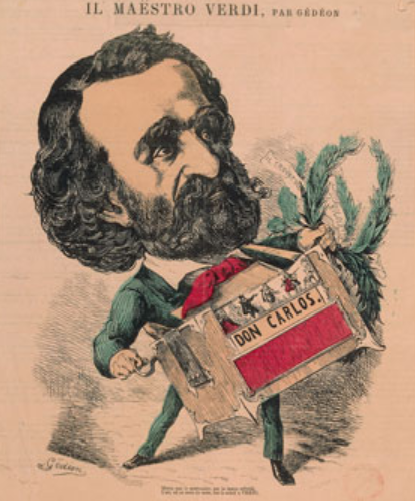
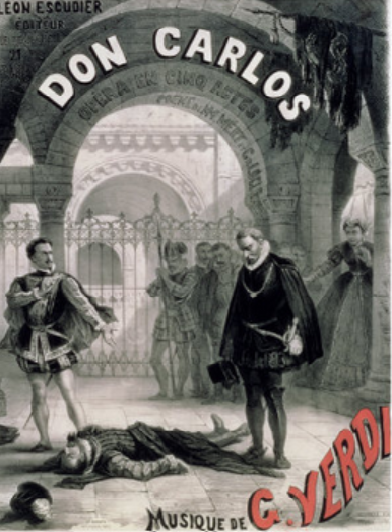
Don Carlos is Giuseppe Verdi’s grand opera, premiered in Paris in 1867. Its complex version history, large-scale music and political themes have made it a central and frequently revised work in the operatic repertoire.
Overview
Don Carlos is a grand opera composed by Giuseppe Verdi. The work was set to a libretto written in the French language by Camille du Locle and Joseph Méry. Verdi drew the dramatic framework from a well-known German theatrical source, the play Don Carlos, Infante of Spain by Friedrich Schiller, and reshaped it to the requirements of the French stage. The resulting score explores conflicts of private feeling and public duty, mixing intimate lyric writing with large ceremonial set pieces.
Image gallery
10 Images



Historical basis and sources
The story is loosely based on the life and tragic fate of Carlos, Prince of Asturias, and on the political and dynastic tensions of the sixteenth-century Spanish court dominated by Philip II. Schiller’s drama had already popularized the tale of a marriage alliance that ends in betrayal and of moral struggle within a royal household; Verdi and his librettists retained those central tensions while adapting scenes and characters to the scale and spectacle expected in Paris.
Composition, premiere and original form
Written specifically for Parisian audiences, Verdi’s score was first presented at the Théâtre Impérial de l’Opéra, Paris on 11 March 1867. In keeping with French grand-opera practice the original conception included a prominent ballet sequence and elaborate stagecraft. The initial full conception was organised in five acts, allowing time for both private scenes and public tableaux.
Versions, cuts and language
Almost immediately the opera entered a long history of revision and editorial adaptation. Outside France the five-act, French-language original proved lengthy for many houses, and substantial cuts were made in nineteenth-century productions; at times entire early scenes were omitted to shorten the running time. From the late nineteenth century into the beginning of the 20th century and beyond, conductors and impresarios presented different performing editions. The work is frequently sung in Italian, under the title Don Carlo, and that translation has itself been the basis for many variant stage versions.
Principal roles and musical character
The drama centres on a relatively compact group of principal figures: Don Carlos (the infante), Elisabeth (the former fiancée, later queen), Philip II (the king), Rodrigo or the Marquis (a noble friend and political foil), Eboli (a noblewoman whose actions are pivotal), and the Grand Inquisitor (a looming representative of religious authority). Musically the opera juxtaposes solo arias, intimate ensembles and large choral and orchestral moments. Verdi frequently reintroduces motives from early scenes later in the score, binding the work’s psychological and political developments through recurrent musical ideas.
Themes and dramatic focus
Major themes include the conflict between personal desire and public obligation, the isolation of sovereign power, the corrosive effects of jealousy and misplaced confidence, and the pressures exerted by institutional religion on conscience and statecraft. Directors and conductors often emphasise different aspects—some foreground the intimate love story, others the political and social consequences of decisions made by rulers and counsellors.
Performance practice and legacy
Because so many different cuts and editions exist, no single "definitive" performing version has been universally accepted; modern productions negotiate which scenes to restore and how to balance dramatic continuity with theatrical practicality. The restoration of material from the original Fontainebleau act has been regarded as important in many 20th- and 21st-century revivals, since music from that earlier act is thematically related to later moments. The dual identity of the work—French grand opera in five acts and the commonly staged Italian Don Carlo in reduced forms—has helped to keep it prominent in the repertory, inviting ongoing reinterpretation by directors and conductors.
Further reading and study
Scholars and enthusiasts consult a range of sources for the libretto, composition history and performance editions; critical editions and annotated scores remain valuable for understanding Verdi’s revisions and the relationship between the French and Italian traditions. For introductions and concise summaries see the references linked in this text, which point to musical, historical and staging studies of the opera.
Key terms and references above: opera, Verdi, libretto, French, German, Schiller play, Don Carlos, Infante of Spain, Friedrich Schiller, Carlos, Prince of Asturias, Philip II, Théâtre Impérial, premiere date, ballet, five acts, early 20th-century restorations, Italian Don Carlo.
Questions and answers
Q: Who composed the opera Don Carlos?
A: Giuseppe Verdi composed the opera Don Carlos.
Q: What language was the libretto for Don Carlos written in?
A: The libretto for Don Carlos was written in French.
Q: What is the story of Don Carlos based on?
A: The story of Don Carlos is based on a famous German play called "Don Carlos, Infante of Spain" by Friedrich Schiller, which is itself based on the true story of the life of Prince Carlso of Asturias (1545-1568).
Q: When and where was Don Carlo first performed?
A: The opera was first performed at the Théâtre Impérial de l’Opéra in Paris on 11 March 1867.
Q: How many acts does it have?
A: Don Carlo has five acts.
Q: Why has this caused a problem with its reputation?
A: Because it was tradition in France to write very long operas that included ballet music as well as singing, when it was performed in other countries it was too long for people's tastes so many cuts were made, including at first, the whole of Act I. This has caused a problem with its reputation because a lot of important music from Act One had to be cut out.
Q: Is there an Italian version of this opera? A: Yes, when sung in Italian it is called "Don Carlo".
Related articles
Author
AlegsaOnline.com Don Carlos (Verdi): history, versions, themes and performance Leandro Alegsa
URL: https://en.alegsaonline.com/art/28342