
Division of Melbourne Ports
Former Australian federal electoral division in inner south‑eastern Melbourne, created 1901; covered ports and inner suburbs and was abolished and renamed Macnamara in 2019.
Overview
The Division of Melbourne Ports was a federal electoral division in the state of Victoria, Australia. Created for the first Commonwealth election in 1901, it originally took its name from the port districts that defined the area. Over more than a century the division encompassed a compact swathe of inner south‑eastern Melbourne, combining industrial waterfront precincts with dense residential neighbourhoods and areas of later urban renewal. For a recent electoral map and boundary details see Melbourne Ports map.
Image gallery
10 Images




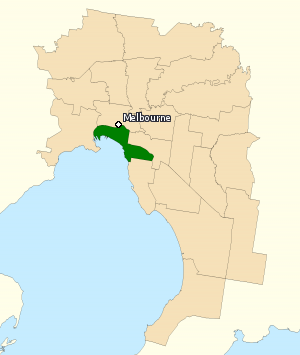


Boundaries and suburbs
The division's limits shifted with periodic redistributions, but at the time of its final configuration it covered a number of well‑known suburbs and localities. These included both longstanding port communities and inner‑city neighbourhoods that underwent significant demographic change in the late 20th and early 21st centuries:
- Port Melbourne and Williamstown (original namesakes)
- Albert Park and Middle Park
- St Kilda, St Kilda East and St Kilda West
- Elwood, Ripponlea and parts of Elsternwick
- Caulfield, Caulfield East and Caulfield North
- South Melbourne, Southbank and parts of Docklands and South Yarra
The division mixed residential streets, commercial strips and waterfront infrastructure; some precincts are characterised by Victorian and Edwardian housing, while others feature modern apartments and redeveloped wharves.
History and development
Melbourne Ports was established at federation and reflected the importance of maritime trade and industry to Melbourne's economy. For decades the port areas and associated industries informed local employment and community life. From the mid‑20th century, industrial decline in some precincts and subsequent urban redevelopment — particularly around the inner harbour and Docklands — changed land uses, population density and social composition. Redevelopment, gentrification and the arrival of new housing and commercial projects altered the character of many suburbs within the electorate. For discussion of urban change in the region consult planning and historical sources such as local histories.
Political character and representation
Throughout its existence the division returned members of the Australian House of Representatives. Its voting patterns evolved with the electorate's changing demographics: periods of industrial working‑class concentration tended to favour one set of parties, while rising professional and inner‑city residential populations produced different electoral dynamics. Over time Melbourne Ports was contested by the major parties and by independents and smaller parties in some elections; it served as an example of how inner‑city boundary changes and social shifts can affect federal representation.
Abolition and successor
Following a redistribution prior to the 2019 federal election, the Division of Melbourne Ports was abolished and largely replaced by a new division named Macnamara. This change reflected adjustments to population distribution and the Australian Electoral Commission's regular review of boundaries. The successor seat retained much of the urban core and many of the communities formerly in Melbourne Ports; contemporary coverage and membership are recorded under the new name. Further administrative information about the redistribution process is available from the official redistribution notices at redistribution resources and local electoral summaries at successor seat guides.
Notable aspects of Melbourne Ports' legacy include its long life as a federation electorate, its mix of port and inner‑city identities, and its reflection of wider economic and social transitions in Melbourne's inner south‑east. Even after abolition, the area's distinct neighbourhoods and civic organisations continue to shape local politics and community life.
Questions and answers
Q: When was the Division of Melbourne Ports first set up?
A: The Division of Melbourne Ports was first set up for the first election in 1901.
Q: What suburbs were included in the Division of Melbourne Ports?
A: The Division of Melbourne Ports included the suburbs of Albert Park, Balaclava, Caulfield, Caulfield East, Caulfield North, part of Elsternwick, Elwood, Middle Park, Port Melbourne, Ripponlea, St Kilda, St Kilda East, St Kilda West, Southbank, South Melbourne and parts of South Yarra and Docklands.
Q: What did the Division of Melbourne Ports cover when it was initially created?
A: When it was initially created the Division of Melbourne Ports covered both Port Melbourne and Williamstown.
Q: When was the Division of Melbourne Ports abolished?
A: The Division of Melbourne Ports was abolished in 2019.
Q: What is the new name for the former electoral division?
A: The former electoral division has been renamed as Macnamara.
Q: How many Australian federal elections did the Division of Melboune ports take part in?
A: The Division took part in all Australian federal elections from 1901 until its abolition in 2019.
Related articles
Author
AlegsaOnline.com Division of Melbourne Ports Leandro Alegsa
URL: https://en.alegsaonline.com/art/27936