
Dither (noise techniques to reduce quantization error)
Dither is the deliberate addition or manipulation of noise to reduce artifacts from quantization or limited palettes in images, audio, and printing, improving perceived fidelity.
Overview
Dither refers to a set of techniques that add or shape noise to mask or redistribute the visual or audible effects of quantization and limited-resolution reproduction. Rather than trying to preserve exact original values when reducing color depth, bit depth, or applying lossy compression, dithering deliberately mixes small random or patterned perturbations so that errors become less noticeable as banding, contouring, or harmonic distortion. Dithering is used in digital images, audio signals, and physical printing where continuous tones must be represented with a finite set of output levels. The result often appears more faithful to a human observer even though every sample may be less accurate in a strict numeric sense.

Image gallery
10 Images


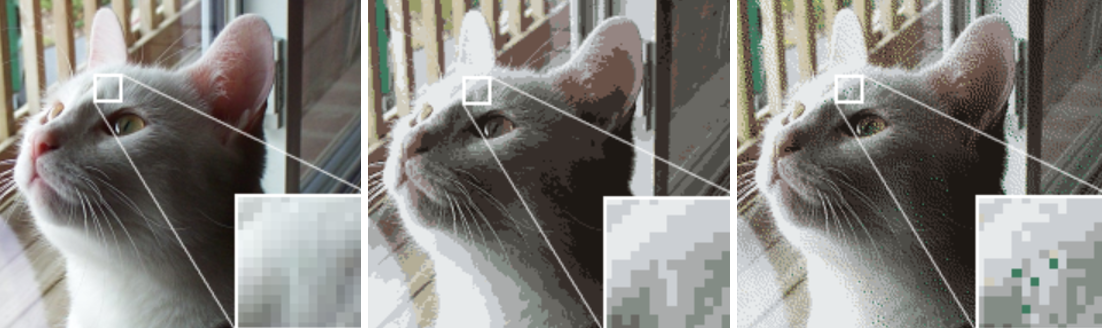


How dithering works
At its core, dithering turns structured quantization error into noise or spreads it so that local averages better match the original signal. In images, this can mean replacing a smooth gradient that would otherwise show visible steps (banding) with a pattern of pixels from the available palette that, when viewed from normal distance, read as an intermediate tone. In audio, low-level noise is added prior to truncation so that the distortion caused by rounding becomes less correlated with the signal and more like harmless background hiss. Two broad mechanisms are common: additive noise (random or spectrally shaped) and error diffusion, which distributes quantization error to neighboring samples.
Common algorithms and approaches
- Ordered (pattern) dithering: Uses fixed matrices (for example Bayer matrices) to threshold pixels according to a repeating pattern. It is fast and predictable but can introduce visible patterns at some scales.
- Error-diffusion dithering: Algorithms such as Floyd–Steinberg push the local quantization error into neighboring pixels, producing a visually pleasing, high-frequency texture that simulates intermediate tones more smoothly. Error-diffusion tends to preserve detail and reduce banding.
- Blue-noise and shaped dithering: These aim to place noise energy at high spatial or spectral frequencies that are less perceptible, improving subjective quality. In audio, noise shaping moves noise out of sensitive frequency bands.
- Halftoning and screening: Printing systems use halftone dots or stochastic screening to simulate continuous tones with ink. These are forms of dithering adapted to physical reproduction.
Uses, examples, and importance
Dithering is widely applied wherever a device must represent continuous or high-resolution content with a restricted set of discrete levels. Typical uses include:
- Reducing banding when saving images in limited palettes or lower bit depths (for example, GIFs or indexed PNGs).
- Smoothing gradients in computer graphics and user interfaces where color precision is constrained.
- Applying audio dither and noise shaping when mastering or converting between bit depths to avoid quantization distortion.
- Printing images with limited inks or dot sizes, where halftone dithering approximates intermediate shades.

Practical considerations and trade-offs
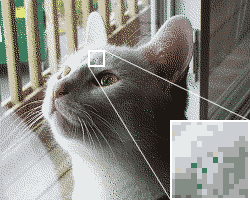
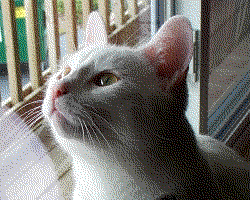
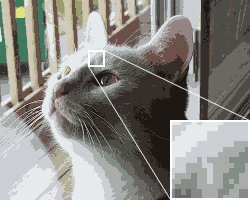
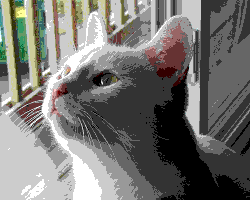
Dithering improves subjective fidelity but has trade-offs. It intentionally adds noise, which can interfere with further processing or compression if not chosen carefully. For example, very aggressive dithering may increase file size after lossless compression because it reduces repetitive regions. In audio, dither levels and noise-shaping choices must match the intended listening environment to avoid audible hiss. When reducing a color palette, combining an optimized palette with appropriate dithering often yields the best visual match to the original; using a poor fixed palette without dithering usually produces flat, posterized output. Examples of these differences are illustrated in the image sequence accompanying this article, where the same source is rendered with and without various dithering strategies.
Further reading
For technical introductions and algorithmic descriptions, see resources that explain error-diffusion and noise shaping in detail. A concise overview suitable for both programmers and designers is available at external resources on dithering and quantization.
Related articles
Author
AlegsaOnline.com Dither (noise techniques to reduce quantization error) Leandro Alegsa
URL: https://en.alegsaonline.com/art/27783