
Alice in Wonderland (1951 film) — Disney animated adaptation
1951 animated adaptation by Walt Disney of Lewis Carroll's Alice's Adventures in Wonderland. A colorful, episodic musical featuring Kathryn Beaumont and Ed Wynn, initially mixed reviews but long-lasting cultural influence.
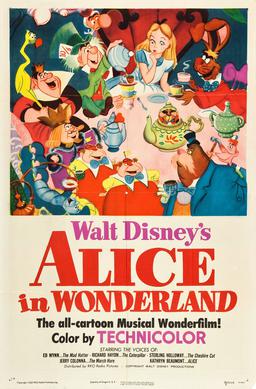
Alice in Wonderland is a 1951 American animated feature produced by Walt Disney and released as part of the studio's early canon of full-length cartoons. The film adapts Lewis Carroll's 1865 novel Alice's Adventures in Wonderland, drawing on its episodic structure and cast of eccentric characters while reshaping material for a family musical. The picture appears in lists of Disney's classic features and is commonly referenced among the studio's mid‑century releases; it is identified as one of the early feature-length animations in the company's catalog (Disney animated classics). The production and film entry are often indexed at official and reference pages about the motion picture itself (film entry).
Image gallery
6 Images


Overview and narrative style
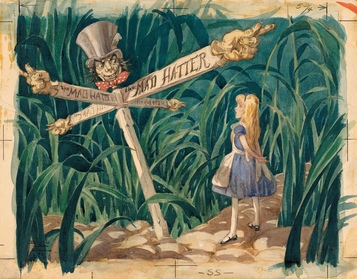
The movie follows a young girl named Alice who slips down a rabbit hole into a dreamlike realm populated by talking animals, skilled eccentrics, and constantly shifting logic. Rather than presenting a tightly unified plot, the film assembles a sequence of vivid vignettes drawn from Carroll's episodes — including encounters with a hurried White Rabbit, the riddle‑speaking Cheshire Cat, the hookah-smoking Caterpillar, a chaotic Mad Hatter tea party, and the tyrannical Queen of Hearts. Animation emphasizes bright color schemes and theatrical staging, and musical numbers punctuate many scenes to move the action and underscore character moments.
Cast, music and creative choices
The lead role of Alice was voiced by Kathryn Beaumont, who later provided the voice of Wendy in Disney's Peter Pan (1953). The Mad Hatter was voiced by Ed Wynn, among a supporting cast that gave distinct personalities to Carroll's gallery of figures. The filmmakers condensed and reordered episodes from Lewis Carroll's work (Lewis Carroll) to fit a feature format, introduced songs and spectacle, and made several narrative adjustments to create a coherent film experience while preserving the original's dreamlike strangeness.
Production background and release
Production reflected the studio's mid‑century animation methods: hand‑inked cells, painted backgrounds, and a studio pipeline that combined storyboarding, layout and musical staging. Upon release the film drew a range of responses — praised by some for its visual imagination and criticized by others for being episodic or tonally uneven — and it performed differently across markets and reissue cycles. Over time the film's reputation has been reassessed by critics and audiences who appreciate its artistry, memorable sequences, and influence on later adaptations.
Legacy, adaptations and distinctions
Disney's Alice in Wonderland has had lasting cultural presence through television, home video, theme park attractions, merchandise and continued citation in discussions of Carroll adaptations. It is notable for translating Victorian nonsense into mid‑20th century screen spectacle and for helping establish several iconic cinematic images associated with Alice's story. The film is often compared with both earlier and later screen versions of Carroll's books, illustrating different approaches to fidelity, tone and stylization.
Where to learn more
- Studio and production context: Walt Disney
- Original literary source: Alice's Adventures in Wonderland by Lewis Carroll
- Film reference pages and classic lists: Disney animated classics, film entry
- Principal voice performers: Kathryn Beaumont, Ed Wynn and related roles such as Peter Pan
Related articles
Author
AlegsaOnline.com Alice in Wonderland (1951 film) — Disney animated adaptation Leandro Alegsa
URL: https://en.alegsaonline.com/art/2595
Sources
- afi.com : "Alice in Wonderland: Detail View"
- bbfc.co.uk : "ALICE IN WONDERLAND (U)"
- imdb.com : imdb.com/title/tt0043274/business