
Algebraic topology: methods for studying shape with algebra
Algebraic topology studies topological spaces by assigning algebraic invariants like groups and rings to capture qualitative features such as holes, connectivity, and higher-dimensional structure.
Overview
Algebraic topology is a field of mathematics that translates problems about geometric shape and continuity into algebraic terms. It assigns algebraic objects—groups, rings, modules—to topological spaces so that questions about connectivity and deformation become questions about algebra. For a concise introduction see algebraic topology resources and for the algebraic background consult abstract algebra. The basic objects of study are topological spaces and continuous maps between them; for background on those see topological spaces.
Image gallery
2 Images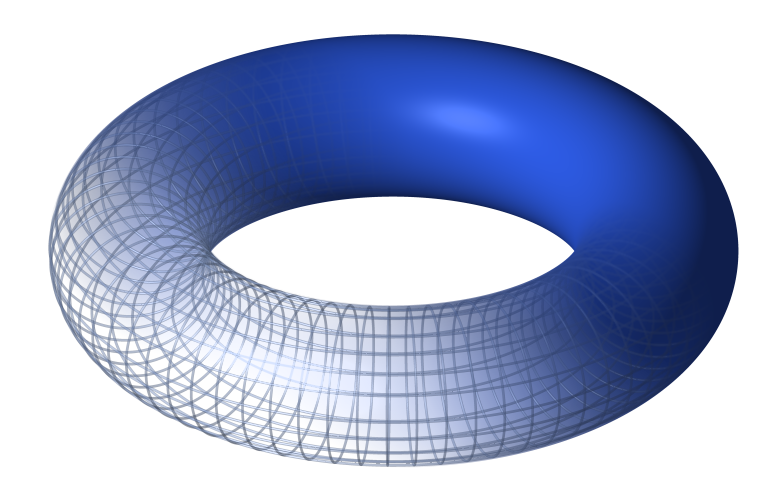

Key concepts and invariants
- Fundamental group (π1): captures loops up to continuous deformation and detects one-dimensional holes.
- Homology groups: measure holes in various dimensions using chains and boundaries; accessible via singular, simplicial, or cellular constructions.
- Cohomology: a related algebraic theory with extra structure (cup product) that often carries more information and connects to geometry.
- Homotopy groups: higher-dimensional analogues of the fundamental group that classify maps from spheres into a space.
- Tools such as exact sequences, Mayer–Vietoris, and spectral sequences tie calculations together and allow decomposition into manageable pieces.
History and development
The subject emerged in the late 19th and early 20th centuries, with Henri Poincaré introducing concepts like the fundamental group. Over the 20th century the discipline matured: homology and cohomology theories were axiomatized, and connections to category theory and homological algebra were developed. Foundational formalizations and computational tools were established by many contributors and are summarized in standard texts and surveys; for connections to geometry see geometric topics.
Applications and importance
Algebraic topology interacts widely with other fields. In physics it provides language for topological phases, defects, and gauge theory (physics applications). In modern number theory and algebraic geometry, analogous ideas appear in étale cohomology and arithmetic duality (number theory links). Applied areas such as topological data analysis use persistent homology to detect structure in data sets.
Examples and intuition
A few standard examples illustrate the ideas. A circle and a coffee cup with a single handle share the same fundamental group because both have one one-dimensional hole. A figure-eight (two circles joined at a point) has a fundamental group reflecting two independent loops. A hollow sphere like a soap bubble has no one-dimensional hole but has a two-dimensional void—this kind of higher-dimensional feature is detected by homology (hollow sphere example). For concrete expositions see additional notes and surveys (algebra references, introductory guides).
Remarks and limitations
Algebraic invariants are powerful but not complete: nonhomeomorphic spaces can share the same homology groups, so finer tools (cohomology rings, homotopy groups, or additional structure) are often needed. Computational methods and software make many calculations feasible today, but certain classification problems remain deep and active areas of research.
Related articles
Author
AlegsaOnline.com Algebraic topology: methods for studying shape with algebra Leandro Alegsa
URL: https://en.alegsaonline.com/art/2534
Sources
- math.rochester.edu : "What is Algebraic Topology?"