
Dance Me to the End of Love — song by Leonard Cohen
A 1984 Leonard Cohen song that blends waltz rhythm, stark imagery and tender devotion. Inspired by wartime stories, widely covered and frequently performed across genres; often called a modern standard.
"Dance Me to the End of Love" is a song written and first released by Leonard Cohen on his 1984 album Various Positions. The piece pairs a simple, waltz-like pulse with Cohen's characteristic plainspoken poetry, producing lyrics that move between intimate devotion and darker historical allusion. Since its release the composition has become one of Cohen's best-known songs and has been interpreted by performers in jazz, folk, classical and popular idioms.
Image gallery
2 Images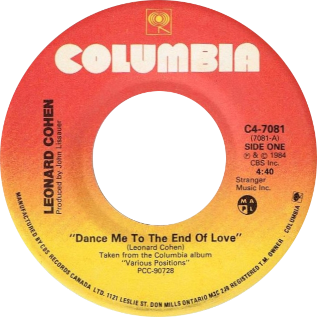

Origins and inspiration
Cohen said the song was inspired by accounts from the Second World War in which musicians were forced to play while atrocities were committed. He turned that image—a violin accompanying unbearable scenes—into a paradoxical love song: the music both consoles and marks the passage toward an ending. The poem-like verses unfold as a series of dances and ceremonies, using ritual movement as a metaphor for intimacy, endurance and mortality.
Musical characteristics
Structurally the song is notable for its slow triple meter, which gives it the feel of a stately waltz rather than a straightforward pop ballad. Instrumentation on many recordings emphasizes bowed strings—violins and cellos—echoing the original idea that conceived the piece. Cohen's baritone vocal delivery keeps the focus on text, while arrangements vary from sparse guitar or piano accompaniments to richly scored chamber textures.
Reception and legacy
Critics and listeners have praised the song for the way it balances tenderness with haunting undertones. In 2009 it was described as "trembling on the brink of becoming a standard," reflecting how frequently it appears in concert repertoires and recordings. Despite its somber inspiration, the song is often chosen for weddings and memorials because of its lyrical emphasis on commitment and an ending made meaningful by love.
Uses, covers and notable features
The song has been recorded by numerous artists across genres and adapted for different vocal and instrumental settings. Common reasons for its popularity include:
- memorable refrain and simple rhythmic structure that invite reinterpretation;
- evocative, image-rich lyrics that allow performers to emphasize romance, tragedy or both;
- compatibility with small ensembles, making it suitable for intimate concerts and film scoring.
While its origin story anchors the song in a specific historical sorrow, its broader themes—dance as ritual, music as witness, and love in the face of time—help explain why "Dance Me to the End of Love" continues to resonate with audiences and musicians decades after its first appearance.
Related articles
Author
AlegsaOnline.com Dance Me to the End of Love — song by Leonard Cohen Leandro Alegsa
URL: https://en.alegsaonline.com/art/25334
Sources
- steynonline.com : Dance Me To The End Of Love · archive.is