
Crotchet (Quarter Note): notation, value, and uses
The crotchet, or quarter note, equals one quarter of a whole note. Explains its notation, stem rules, relations to other notes, role in time signatures, history, and practical uses.
The crotchet, commonly called the quarter note in American English, is a fundamental rhythmic unit in modern Western musical notation. Its basic value is one quarter of a whole note (semibreve). Because it frequently serves as the principal pulse in many pieces, it is often introduced early in musical education and commonly described to beginners as "one beat" when the meter assigns the crotchet as the beat unit.
Image gallery
2 Images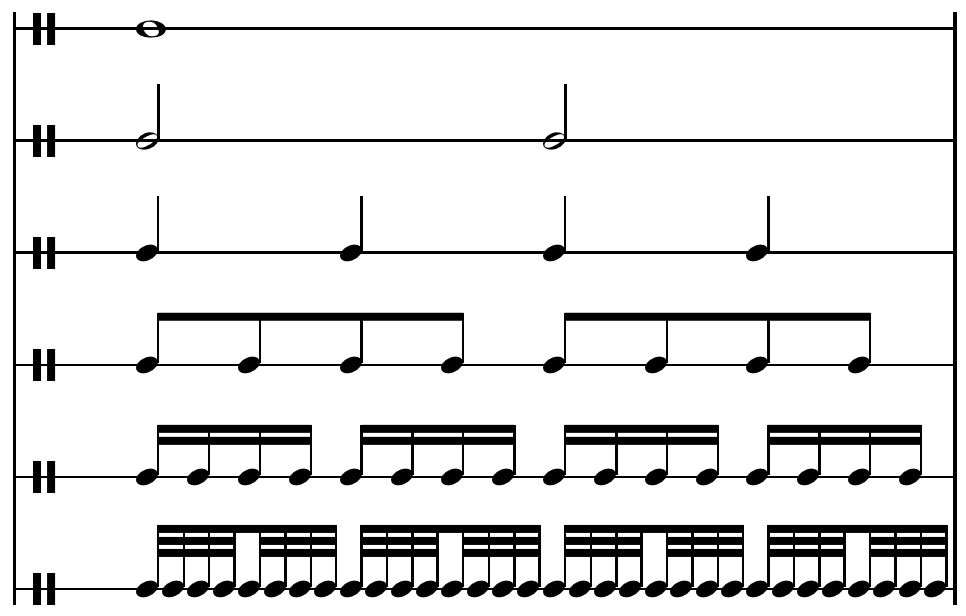
Notation and basic features
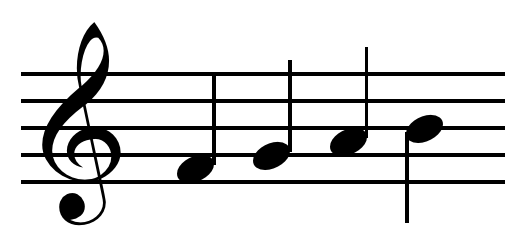
Visually, a crotchet is written as a filled-in (solid) oval note head with a straight stem attached and no flag. The stem may point upward or downward depending on the note's vertical position on the staff: stems usually point up when the note head sits below the staff's middle line and down when the note head is on or above that line. In practice this helps keep musical notation tidy and balanced on the staff. A crotchet rest, representing silence of equal duration, is notated with a distinct squiggled symbol commonly known as the quarter rest.
Value relationships and variations
In simple arithmetic of note values, two crotchets equal one minim (half note), and four crotchets equal one semibreve (whole note). A quaver (eighth note) is half a crotchet. Adding a dot to a crotchet (a dotted crotchet) increases its duration by half its original value, producing a length equal to three quavers. The crotchet is also frequently used in tempo markings and metronome settings to indicate the intended beat: for example, a tempo may specify the number of crotchet beats per minute.
Context, meter, and practical use
Whether a crotchet corresponds to one counted beat depends on the time signature. In meters such as 4/4, 3/4 or 2/4 the crotchet commonly functions as the beat unit; in other signatures the beat may instead be a minim or another value. Beginner students are often taught with pieces where the crotchet equals one beat because those meters are easier to conceptualize. In ensemble and pedagogical settings the crotchet's steady pulse underpins phrasing, accent patterns, and tempo stability.
History, terminology and notable facts
The English term "crotchet" comes from an Old French word meaning "little hook," reflecting an earlier form of notation. Different English-speaking regions use alternate names: "crotchet" in British usage and "quarter note" in American usage. Notation conventions also allow stems to be written in the opposite direction to indicate separate voices on the same staff, and in keyboard or choral music crotchets are organized with stems and beamings that clarify rhythmic groupings and voice-leading.
Quick reference and common conventions
- Appearance: solid (black) oval note head + stem, no flag.
- Value: 1/4 of a whole note; equal to 2 quavers (eighth notes) or 1/2 a minim (half note).
- Rest: represented by the quarter rest symbol for an equivalent silence.
- Stem direction: up if below the staff's middle line, down if on or above it; exceptions occur for multi-voice notation.
- Meter role: may or may not be the beat depending on the time signature; commonly the beat in 2/4, 3/4, 4/4 while other meters assign beats differently.
For a visual example of a filled note head and stem see note illustration, and for information on how the staff is organized consult material about the staff (stave). Guidance on stem direction is available in basic notation references at stem direction, while details on beat assignment and common time signatures can be found under time signatures.
Related articles
Author
AlegsaOnline.com Crotchet (Quarter Note): notation, value, and uses Leandro Alegsa
URL: https://en.alegsaonline.com/art/24364