
County of London (1889–1965)
Former administrative county of England established in 1889 and abolished in 1965; governed by the London County Council and roughly coextensive with today’s Inner London.
Overview
The County of London was an administrative county of England created in 1889 and abolished in 1965. It covered the central urban area of London outside the ancient City of London and corresponds broadly to what is now called Inner London. The county introduced elected local government for the metropolis and was the principal urban authority for public services and planning within its borders for most of the late 19th and first two-thirds of the 20th century.
Image gallery
3 Images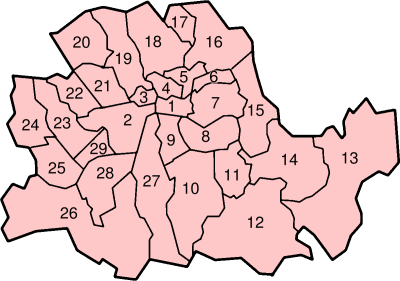


Establishment and governance
The county was established under the Local Government Act 1888, which created county councils throughout England and Wales. The new London County Council (LCC) replaced older, less democratic arrangements and took over many responsibilities formerly managed by ad hoc boards. The City of London retained its separate corporation and ancient privileges and was not part of the County of London.
Territory and subdivisions
When formed, the county consolidated a patchwork of parishes, vestries and local boards into a single administrative unit. In 1900 the area was reorganised into metropolitan boroughs, a second-tier division that simplified local administration. The county was considerably smaller than the Greater London area created later; its boundaries included central districts on both sides of the Thames but excluded many suburban districts that expanded rapidly during the 20th century.
Functions and public role
The London County Council carried out a wide range of municipal functions. These included town planning, main roads, housing and slum clearance, public education, public health, and parks. The LCC became known for large-scale municipal building programmes, the expansion of public schooling, and improvements in urban infrastructure. Its work influenced debates about municipal socialism and the role of local government in providing social services.
Abolition and succession
The administrative County of London was abolished in 1965 under a reorganisation that created Greater London and a two-tier system of newly formed London boroughs together with the Greater London Council (GLC). The reorganisation incorporated many suburban districts that had previously been outside the county; the City of London continued to exist as a separate corporation within the new Greater London area.
Legacy and significance
Although the County of London no longer exists as an administrative unit, its boundaries and institutions shaped the modern metropolis. The term "Inner London" in planning and statistics derives from much of the same area, and the LCC's achievements in housing, education and public amenities left a visible imprint on the city. The county period marks a key phase in the development of democratic municipal government in London.
Related articles
Author
AlegsaOnline.com County of London (1889–1965) Leandro Alegsa
URL: https://en.alegsaonline.com/art/23539