
Communications-based Train Control (CBTC): Principles, Components, and Applications
CBTC is a modern railway signaling approach using continuous train-to-track communications to improve safety, capacity, and operational flexibility on metros and other railways.
Overview
Communications-based train control (CBTC) is a railway signaling approach that relies on continuous telecommunications between onboard equipment and wayside systems to manage train movement. Unlike traditional fixed-block signaling, CBTC enables the control centre and adjacent trackside devices to locate trains with higher precision and update movement authorities in near real time. This permits shorter separation between trains while maintaining safety, improving throughput and timetable reliability on busy networks.
Image gallery
5 Images


How it works and main components
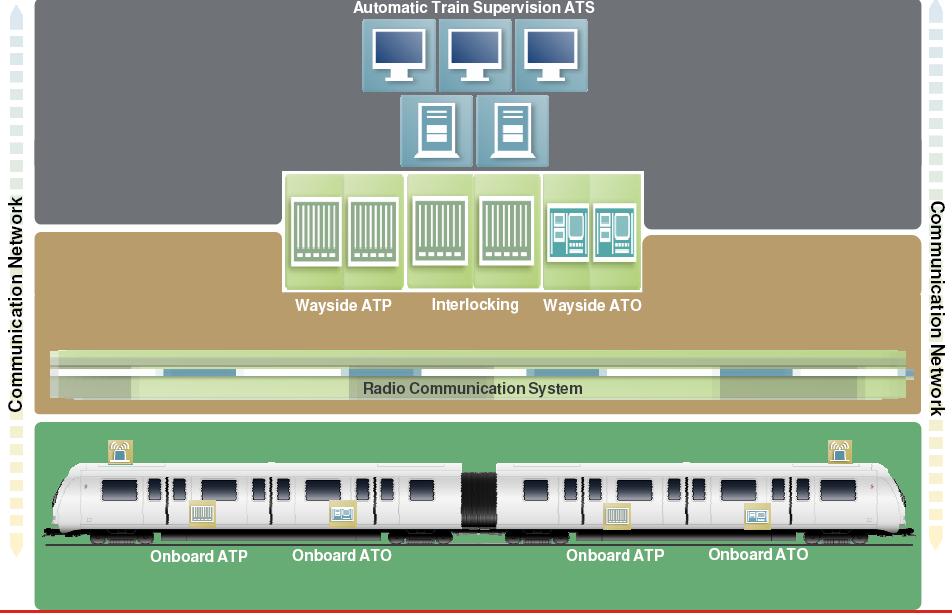
At its core, a CBTC installation combines continuous data exchange, precise position determination, and traffic management logic. Typical elements include:
- Onboard systems: sensors, speed controllers and radio or wireless transceivers that report position and receive movement instructions.
- Wayside equipment: zone controllers, transponders or beacons where fitted, and radio base stations that relay information to and from trains.
- Control centre: traffic supervision software that issues movement authorities, supervises headways and adapts service patterns.
- Communication network: a resilient radio or wireless backbone that supports secure, low-latency exchanges.
Variants and operational principles
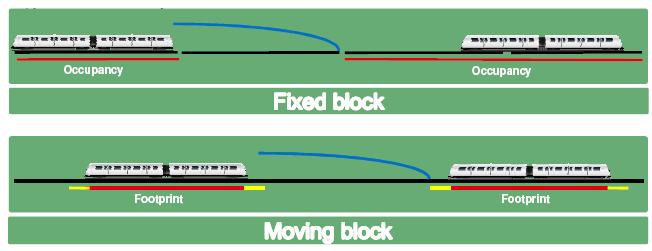
CBTC systems can operate in modes such as fixed-block (where track is still divided into discrete sections) or moving-block (where safe separation is calculated dynamically). Moving-block implementations, when safe and validated, allow the greatest capacity gains because safe braking distances rather than fixed physical sections determine train separation.
History and development
CBTC evolved as digital communications, onboard sensing and software matured in the late 20th and early 21st centuries. Growing urban rail demand led operators to seek technologies that could increase service frequency without costly tunnel or track expansion. Industry activity produced supplier solutions and guidance documents to improve safety, performance and interoperability across different systems.
Benefits, uses and notable considerations
- Increased line capacity and reduced headways, especially valuable on metro and urban rail networks.
- Potential for energy savings, smoother operation and improved timetable adherence.
- Less dependence on wayside signals in some designs, reducing physical infrastructure in tunnels and stations.
Challenges include upfront cost, careful migration from legacy signaling, interoperability between suppliers and attention to cybersecurity and rigorous safety certification. For further technical background see railway signaling resources and material on train-to-track communications.
Related articles
Author
AlegsaOnline.com Communications-based Train Control (CBTC): Principles, Components, and Applications Leandro Alegsa
URL: https://en.alegsaonline.com/art/22164