
Caesar's Comet (Comet C/-43 K1)
Bright non‑periodic comet observed in 44 BC and widely read by Romans as a sign of Julius Caesar's deification; notable for exceptional brightness and a parabolic orbit.
Overview
Caesar's Comet, catalogued as C/−43 K1 and sometimes called the Great Comet of 44 BC, was a brilliant non‑periodic comet seen in the months following the assassination of Julius Caesar. Contemporary reports emphasize an unusually strong appearance that lasted several days and captured the attention of Roman writers and the general public. Modern astronomers reconstruct its behaviour from those historical accounts and from physical models of cometary motion.
Image gallery
4 Images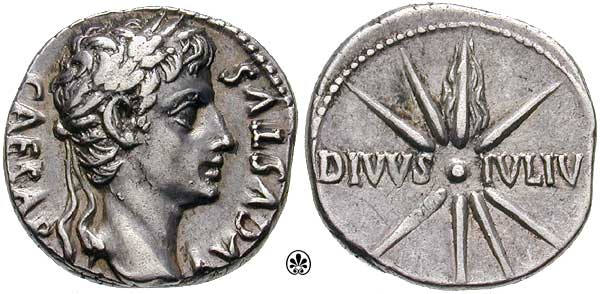


Appearance and orbital characteristics
Ancient observers described a comet that was visible in daylight on at least one occasion and that remained prominent for about a week. Such reports have led to brightness estimates placing the object among the few comets to have had a negative absolute magnitude, implying exceptional intrinsic luminosity. Studies of its path conclude it followed a near‑parabolic trajectory rather than a closed periodic orbit; therefore it was not expected to return on human timescales. Current orbital reconstructions suggest it may now lie at great distance from the Sun, perhaps over 800 astronomical units.
- Notable traits: extreme brightness, daylight visibility, seven‑day prominence.
- Orbit type: essentially parabolic (non‑periodic).
- Modern status: receded into the outer reaches of the Solar System.
Historical and cultural significance
Romans connected the comet with the recently murdered dictator Julius Caesar, interpreting it as a portent of his elevation to divine status. Funeral and political uses of the sighting—reported by various Roman authors—helped propagate the narrative of Caesar's deification. For summaries of the surviving ancient testimony see Roman sources and discussions in modern overviews of the period (ancient observers).
Modern study and legacy
Contemporary astronomers and historians combine textual evidence with orbital modelling to estimate the comet's brightness and path. Research refers to detailed analyses of its apparent luminosity (brightness estimates) and to calculations of its trajectory (orbital details). The object remains a touchstone in studies of how celestial events influence politics and religion; it also figures in catalogues of historically significant comets (astronomical context).
Because observational records from antiquity are fragmentary, some parameters are uncertain: modern distance estimates and projections of current location rely on models rather than direct observation. For summaries of the latest assessments and distance estimates see modern distance estimates and general historical reviews (ancient observers, brightness estimates).
Questions and answers
Q: What is Caesar's Comet and what are its other names?
A: Caesar's Comet is a famous comet that appeared in ancient times. It is also known as 'Comet Caesar' and the 'Great Comet of 44 BC'.
Q: Why did many Romans consider Caesar's Comet a sign of the deification of Julius Caesar?
A: Many Romans believed that the seven-day appearance of Caesar's Comet was a sign of the deification of Julius Caesar, who had been recently assassinated.
Q: Was Caesar's Comet periodic or not?
A: Caesar's Comet was not periodic.
Q: How bright was Caesar's Comet?
A: Caesar's Comet may have been the brightest daylight comet in history. It had a negative absolute magnitude.
Q: What was the orbit of Caesar's Comet?
A: Caesar's Comet had a parabolic orbit.
Q: How far from the Sun might Caesar's Comet be now?
A: Caesar's Comet might now be more than 800 AU from the Sun.
Q: How many comets are known to have had a negative absolute magnitude?
A: Caesar's Comet was one of only five comets known to have had a negative absolute magnitude.
Tags
Related articles
Author
AlegsaOnline.com Caesar's Comet (Comet C/-43 K1) Leandro Alegsa
URL: https://en.alegsaonline.com/art/15952
Sources
- ssd.jpl.nasa.gov : "Horizon Online Ephemeris System"