
Cavaquinho — Portuguese four‑stringed instrument
Small four‑stringed instrument from the guitar family, central to Portuguese and Brazilian music and ancestral to the ukulele; notable for varied tunings and rhythmic role.
Overview
The cavaquinho is a small, four‑stringed instrument in the European guitar family, known for its bright, percussive sound. Though compact, it serves both rhythmic and melodic functions. Historically strings were gut or metal wire; modern instruments often use nylon or steel strings.
Image gallery
5 Images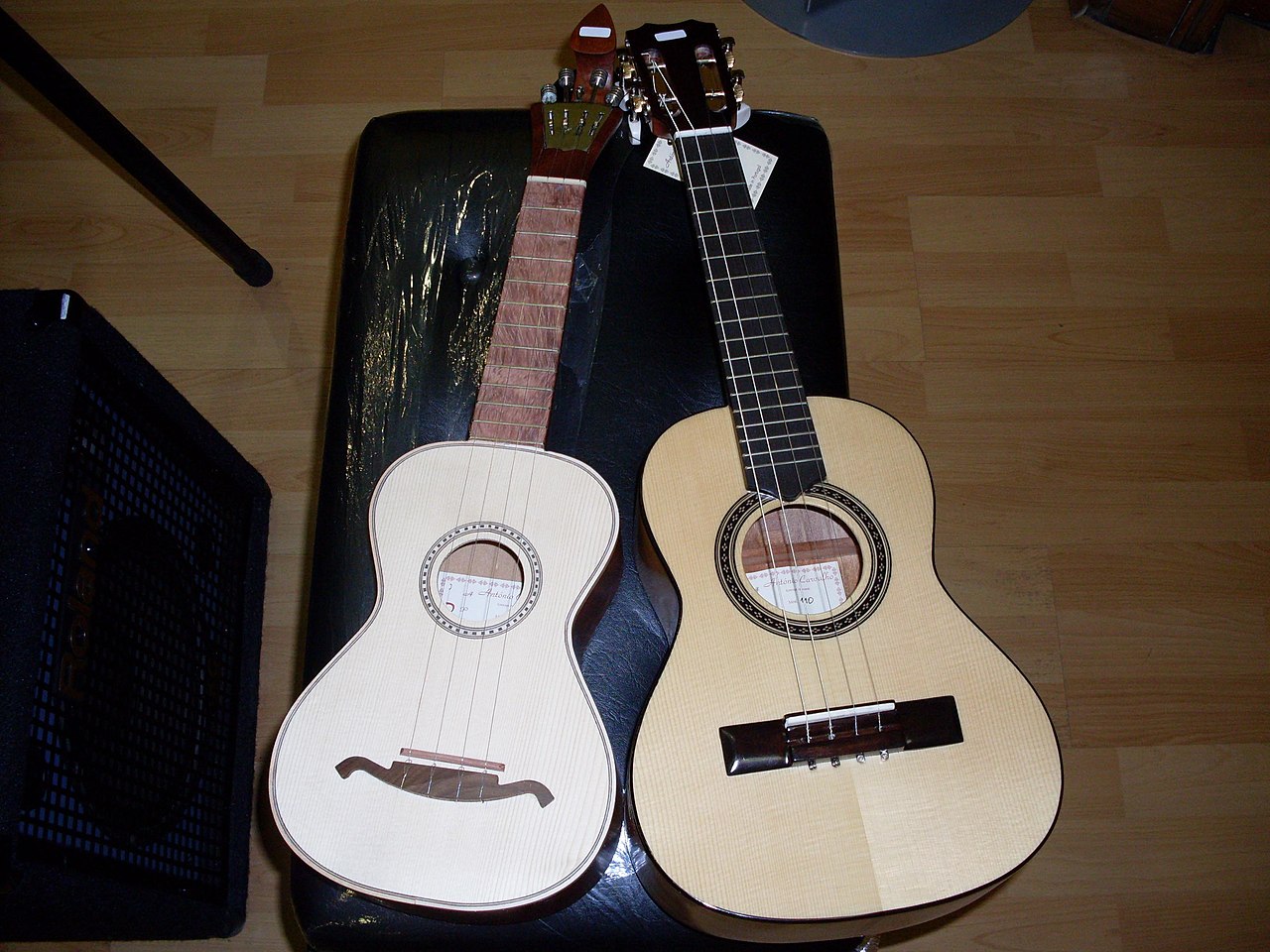


Characteristics and tunings
Typical cavaquinhos have a small hollow body, a fretted neck and four strings. Players choose different tunings to suit repertoire or to mimic other instruments. Common tunings include:
- D–G–B–D (often regarded as a standard in some traditions)
- D–A–B–E (an older Portuguese variant popularized by some contemporary players)
- G–G–B–D and A–A–C♯–E (regional or stylistic variants)
- D–G–B–E and G–C–E–A (used to imitate the highest four guitar strings or the soprano/tenor ukulele)
History and cultural role
The cavaquinho has roots in Iberian stringed instruments and evolved through regional craft traditions in Portugal and its islands. In the late 19th century, Portuguese immigrants took small string instruments of this family to Hawaii, where they influenced the development of the ukulele. Over time the cavaquinho also became established in Brazil and other Lusophone communities, adapting to local musical styles.
Uses and repertoire
In Portugal the cavaquinho appears in folk music and popular urban genres; in Brazil it is important in choro, samba and other popular forms, typically providing rhythmic drive and occasional melodic lines. It can be strummed with the fingers or a pick and is often paired with guitars, percussion and wind instruments.
Distinctions and notable facts
Although visually similar to small ukuleles, the cavaquinho differs in typical tuning choices, repertory and playing techniques. Its versatility—multiple tunings, simple construction and lively tone—has made it a durable element of Iberian and Brazilian musical life and a direct ancestor to several small‑stringed instruments worldwide.
Tags
Related articles
Author
AlegsaOnline.com Cavaquinho — Portuguese four‑stringed instrument Leandro Alegsa
URL: https://en.alegsaonline.com/art/17726