
Caucasian Albania: an ancient polity of the eastern Caucasus
Ancient polity in the eastern Caucasus covering parts of modern Azerbaijan and southern Dagestan; notable for its distinct Caucasian Albanian language, early Christianization, and archaeological remains.
Caucasian Albania was an historical polity of the eastern Caucasus whose territory lay largely within what is now Azerbaijan and extended into southern Dagestan. The name in Greek and Latin sources — "Albania" — is unrelated to the modern Balkan state; to avoid confusion the region is commonly called Caucasian Albania and is sometimes rendered in medieval sources as Arran or by local ethnonyms recorded by neighbouring peoples. The precise native name for the polity is not firmly established in surviving sources.
Image gallery
10 Images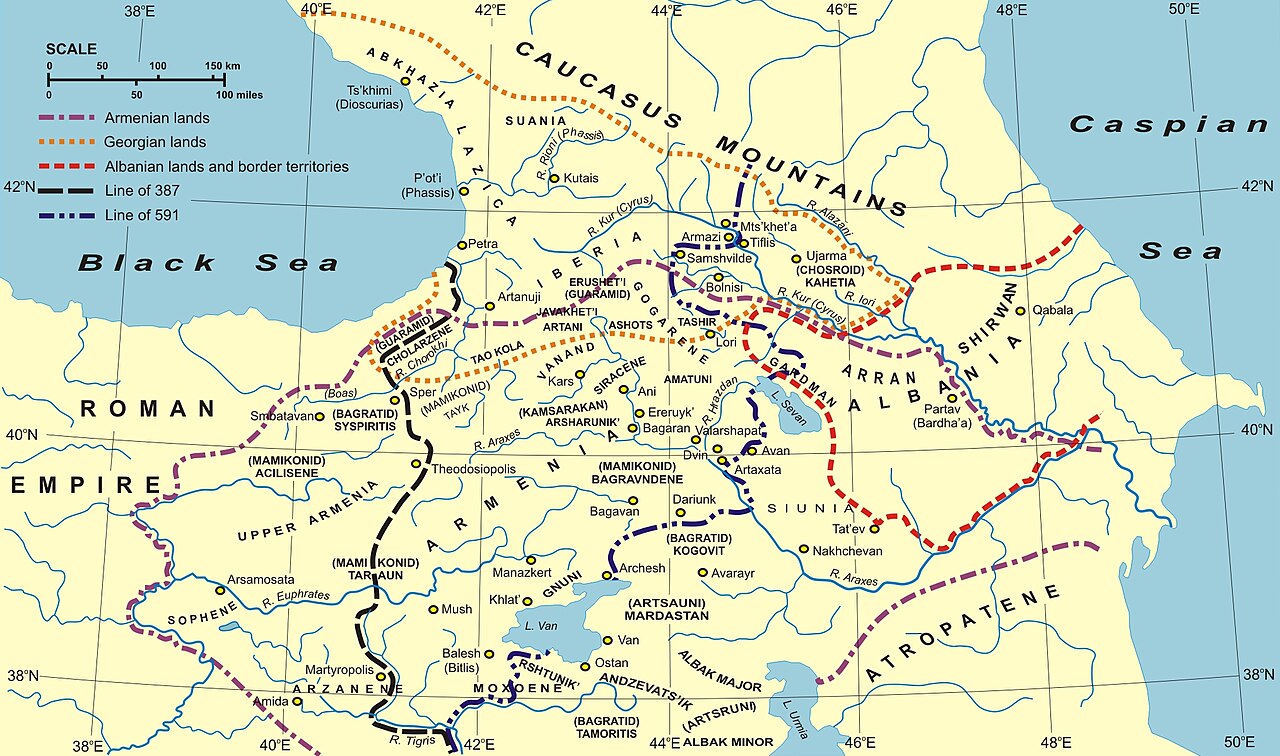



Geography and organization
The state occupied river valleys and mountain foothills of the eastern Caucasus, a crossroads between the Black Sea and Caspian cultural spheres. Early and medieval centres recorded in historic sources and supported by archaeology include the ancient city often identified as Qabala (Gabala) and the later political centre around Barda (Partav). Its position made it a frontier zone influenced alternately by Iranian, Armenian, Roman/Byzantine and later Arab powers.
Language, religion and culture
Caucasian Albania possessed a distinct linguistic and cultural profile. A local language related to the Northeast Caucasian family is attested in fragments and in later Udi speech, a language still spoken by a small community today. A native alphabet used for liturgical and administrative texts is known from manuscript material and inscriptions. Religiously, the country originally practised local pagan cults and was gradually Christianized under the influence of neighbouring Armenia and the wider Christian world; later centuries witnessed the arrival of Islam after Arab expansion, producing a complex religious landscape.
History and political development
Described in classical, Armenian, Georgian and early Islamic sources, Caucasian Albania existed from antiquity into the early medieval period. Its rulers frequently formed client relationships or vassal ties with larger powers to the south and west, including Persian and Roman/Byzantine states, and the territory was repeatedly contested in regional struggles. Arab conquests and the shifting balance of power in the early medieval era led to administrative and cultural transformations, after which the historical political structures of Caucasian Albania ceased to exist as an independent kingdom.
Legacy, archaeology and modern relevance
Archaeological excavations, inscriptions and surviving manuscript fragments illuminate local art, burial customs and urban life. The Udi people are commonly regarded as descendants of the Caucasian Albanian population; their language and some liturgical traditions preserve links to that past. Scholars study Caucasian Albania to understand interactions among Iranian, Turkic, Armenian and indigenous Caucasian cultures and to trace the region’s role in early Christian and Islamic frontiers.
Key points and common confusions
- Caucasian Albania is not the same as the modern nation of Albania in the Balkans; the similarity in name is coincidental in ancient exonyms.
- The polity occupied much of eastern Caucasus territory described in geographic sources as part of the Caspian hinterland (eastern Caucasus).
- Remnants of language, a unique script and archaeological sites provide the principal evidence for its existence and culture.
Research into Caucasian Albania remains active: ongoing archaeological fieldwork and manuscript studies continue to refine understanding of its institutions, population and role in regional history.
Related articles
Author
AlegsaOnline.com Caucasian Albania: an ancient polity of the eastern Caucasus Leandro Alegsa
URL: https://en.alegsaonline.com/art/17671
Sources
- iranicaonline.org : Arran