
Cardinality of sets: measuring the size of finite and infinite collections
Explore cardinality: how mathematicians define and compare the size of finite and infinite sets using bijections and injections, and classify sets as finite, countable, or uncountable.
In mathematics, the term cardinality describes how many elements belong to a particular set. For instance, the set A = {2, 4, 6} contains three elements, so its cardinality is three. The size of a set A is often written as the vertical-bar notation |A| .
Image gallery
10 Images


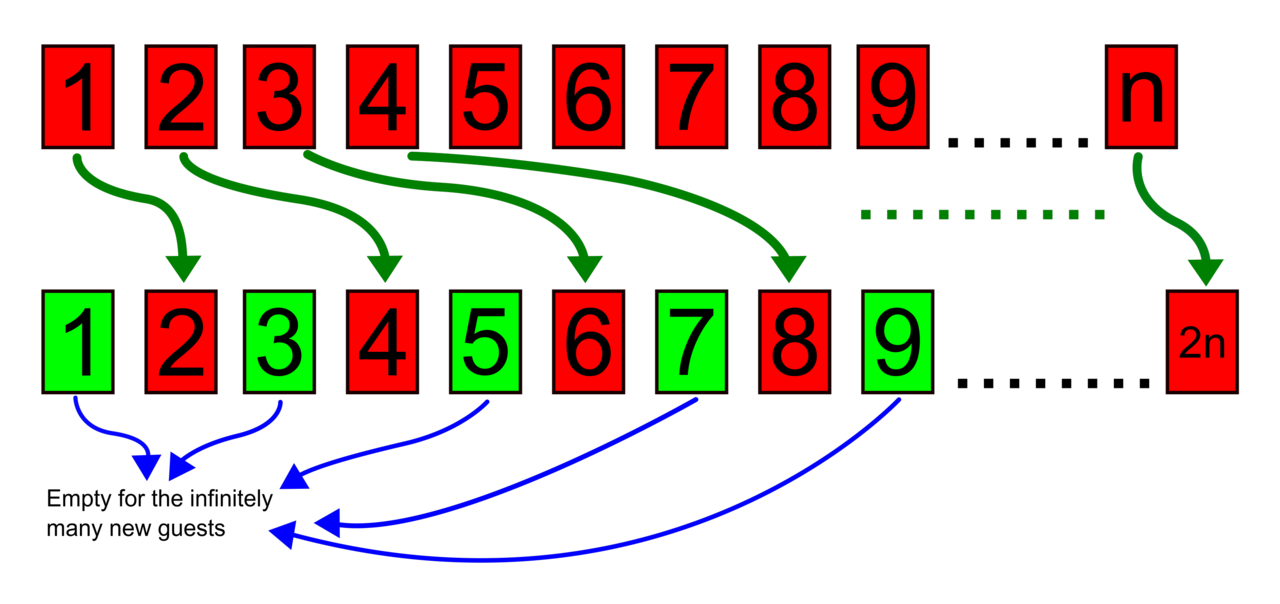






Comparing sizes of sets
Two sets are said to have the same (or equal) cardinality precisely when there exists a one-to-one correspondence between their members. In other words, a pairing that matches each element of one set to exactly one element of the other (and vice versa) shows the sets share the same cardinality.
To express that the cardinality of A is less than or equal to that of B, one can provide an injective function from A into B. If such an injection exists, every element of A maps to a distinct element of B, so no two elements of A share an image in B. The reverse statement—an injective map from B into A—similarly implies the cardinality of B is at most that of A.
Finite and infinite cardinalities
If a set has a finite number of elements, its cardinality is a natural number (0, 1, 2, …). Infinite sets do not have a natural-number size; instead, their cardinalities are compared using correspondences such as injections, surjections, and bijections. Some infinite sets can be matched one-to-one with the integers and are called countably infinite, while others cannot and are called uncountable; these notions allow a finer classification of infinite sizes.
Cardinality versus other notions of size
Cardinality is one formal way to assign a size to a set by counting or by establishing correspondences. Other mathematical concepts, for example measures in analysis, quantify different aspects of "size" (like length, area, or probability) and serve different purposes than cardinality.
Tags
Related articles
Author
AlegsaOnline.com Cardinality of sets: measuring the size of finite and infinite collections Leandro Alegsa
URL: https://en.alegsaonline.com/art/16947