
Burette: Laboratory Glassware for Precise Liquid Dispensing
A burette (also spelled buret) is a graduated laboratory tube with a stopcock used to dispense and measure variable, precise volumes of liquid—commonly used in titrations and volumetric analysis.
Overview
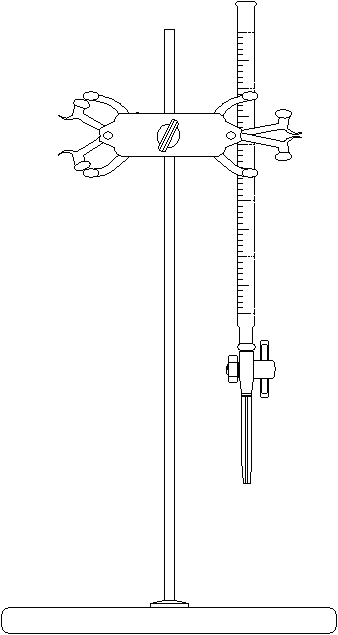
A burette is a long, narrow, graduated tube with a tap or stopcock at the bottom that allows controlled release of liquid. It is a standard piece of volumetric glassware in chemistry and other laboratory disciplines where accurate dispensing is required. Burettes come in several capacities, are usually graduated in millilitres, and can measure delivered volumes to a high degree of precision.
Image gallery
6 Images


Design and key parts
Typical components include a calibrated glass or plastic tube, a series of etched or printed graduation marks, and a stopcock made of glass or chemically resistant plastic (PTFE). The top may be open for filling or fitted with a funnel, and the bottom terminates in a narrow tip through which the content is released. Users read the meniscus against the scale to determine the initial and final readings; the dispensed volume equals their difference.
Uses and technique
Burettes are primarily used for titrations—slowly adding a reagent of known concentration to a sample until an indicator shows the reaction end point. Proper technique includes rinsing the burette with the solution to be used, filling without air bubbles in the tip, and reading the lower meniscus at eye level to avoid parallax. Typical capacities encountered in teaching and research are 25 mL and 50 mL, and many burettes can achieve precision on the order of hundredths of a millilitre.
Variants and modern developments
Beyond classical glass burettes, versions include plastic burettes for corrosive media, digital or mechanical burettes that display delivered volume, and automated titrators that integrate sensing and dosing for higher throughput or remote operation. Some stopcocks are designed for fine control, while others are quick-release for larger flows.
Comparison and notable points
- Burette vs pipette: a burette dispenses variable volumes with high precision; a volumetric pipette transfers a single fixed volume.
- Cleaning and handling are important: residues and air bubbles reduce accuracy, and incompatible chemicals may damage glass or seals.
- Spelling: both "burette" and the American variant "buret" are commonly used.
When correctly used and maintained, the burette remains one of the simplest and most reliable tools for quantitative liquid measurement in analytical chemistry and education.
Tags
Related articles
Author
AlegsaOnline.com Burette: Laboratory Glassware for Precise Liquid Dispensing Leandro Alegsa
URL: https://en.alegsaonline.com/art/15390