
What Price Glory? (1952 film)
1952 John Ford-directed cinematic remake of the World War I comedy-drama, starring James Cagney and Dan Dailey, adapted from an earlier stage play and the 1926 screen version.
Overview
What Price Glory? (1952) is a Hollywood feature set in the First World War that uses broad comedy and military rivalry to explore camaraderie, romance, and the absurdities of life at the front. The picture is a talking‑picture remake of an earlier silent-era hit and was distributed by 20th Century Fox. It was directed by a leading American filmmaker of the era, John Ford, and assembled a cast of established screen personalities and younger contract players.
Image gallery
1 Image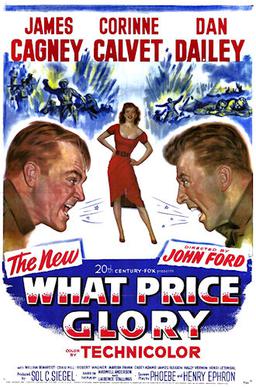
Plot and main themes
The narrative follows the ups and downs of two rival U.S. Marines stationed in Europe whose competitive relationship spills into comic quarrels, flirtations, and reluctant partnership when duty calls. The film balances slapstick and pointed banter with moments that underline the strains of wartime service and the resilience of small‑unit bonds. Rather than a gritty trench drama, the tone leans toward farce and romantic entanglement grounded by military routine.
Cast and production
The production featured James Cagney in a key role, supported by Dan Dailey, Corinne Calvet, Wally Vernon, James Gleason and a young Robert Wagner. For information on the leading actor, see James Cagney; a later supporting performer from the film is listed at Robert Wagner. The 1952 release reworked material that had earlier been presented on stage and on screen, updating dialogue, pacing and comic set pieces for post‑war audiences.
Historical background and relation to earlier versions
The story traces its origins to a popular stage play of the 1920s and was first adapted for film in 1926. The 1952 movie is explicitly a remake, reinterpreting the earlier silent and early-sound approaches in a mid‑century studio context; its status as a remake is noted in contemporary publicity and catalogues of studio releases. See the earlier adaptation referenced as the 1926 film for comparison.
Reception and legacy
Upon release the picture received mixed notices: some reviewers praised its comic performances and the chemistry among leads, while others felt the remake lacked the sharper edge of the original stage material. Today it is often discussed as part of the mid‑20th century tendency to revisit pre‑sound properties and as an example of how established directors approached lighter, military-themed entertainment.
Notable aspects
- Genre blend: mixes broad comedy, romantic rivalry and wartime setting.
- Remake context: part of a trend of reworking earlier theatrical and silent films for modern audiences.
- Director's role: represents a less typical assignment for a director often associated with westerns and dramatic work.
- Cast highlights: features both star names of the studio era and performers who would continue into later decades.
For further reading on the director and principal performers, consult actor and filmmaker entries: John Ford, James Cagney, and references for other cast members such as Robert Wagner.
Author
AlegsaOnline.com What Price Glory? (1952 film) Leandro Alegsa
URL: https://en.alegsaonline.com/art/147737