
United States Electoral College
Comprehensive overview of the U.S. Electoral College: composition, how electors are allocated and chosen, historical origins, operation on election day, controversies, and common reform proposals.
The United States Electoral College is the constitutional mechanism for the formal selection of the President and Vice President. It is made up of a fixed group of presidential electors who meet after each quadrennial general election to cast the official votes that determine the nation’s executive officers. These individuals are commonly called presidential electors; they formally choose the President and Vice President of the United States.
Image gallery
9 Images



Composition and apportionment
The number of electors allocated to each state equals that state’s total membership in the U.S. Congress: its number of Representatives plus its two Senators. Every state therefore has at least three electors. The House of Representatives and the Senate together produce the state apportionments used to determine electors, and the 23rd Amendment grants the District of Columbia three electors even though it is not a state. The total number of electors currently is fixed so that a majority—more than half of the whole body—is required to win the office. If no candidate achieves that majority, the Constitution and subsequent amendments set out a contingent procedure for selecting the President and Vice President.
How electors are chosen and how they vote
State governments decide how electors are selected. In modern practice, political parties in each state nominate slates of pledged electors, and the voters choose among the candidates on the ballot. Most states use a statewide, winner-take-all method in which the ticket receiving the most popular votes in the state receives all of that state’s electors. A small number of jurisdictions allocate electors by congressional district or by other proportional rules; the district-based approach is famously used in Maine and Nebraska, where some electors are tied to district outcomes while the statewide winner receives the remaining electors. For information on district allocation approaches, see congressional district methods.
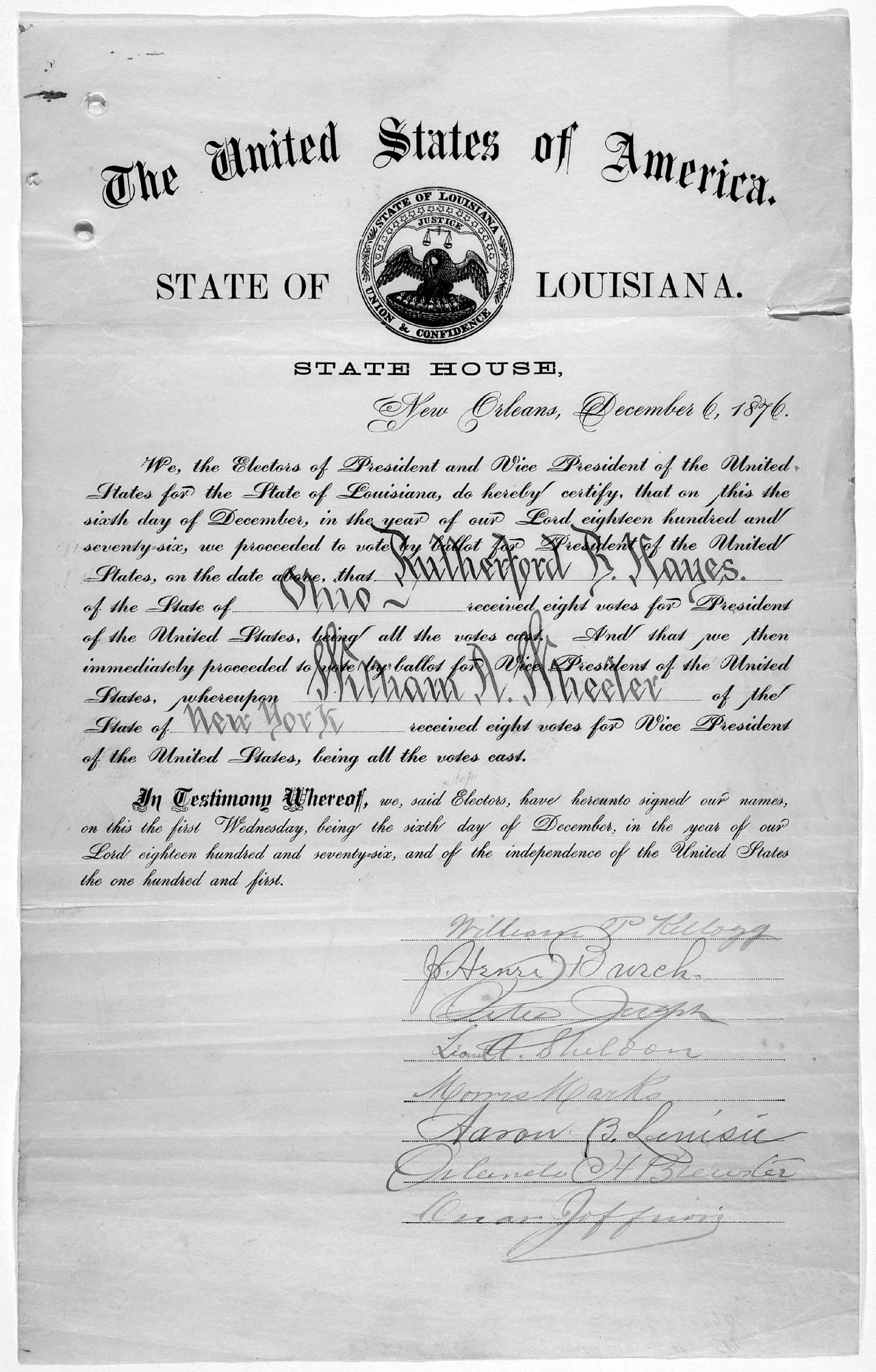
Once chosen, electors meet in each state capital on a date set by federal law to cast separate ballots for President and Vice President. State law largely governs whether electors are bound to vote for the candidate to whom they were pledged. Those who vote contrary to state law or to their pledge are sometimes called faithless electors. Some states provide penalties or replacement procedures to limit faithless votes, and the Supreme Court has ruled that states may enforce laws that direct how electors must vote.
Origins, evolution, and rationale
The Electoral College was created during the Constitutional Convention as a compromise between direct popular election and selection by Congress. Delegates debated alternatives and sought a system that would balance popular influence with a role for the states and for deliberation by appointed electors. The system’s design was later adjusted by the 12th Amendment after the early republic encountered practical difficulties when political parties emerged. Supporters historically argued the Electoral College protects federalism and encourages candidates to campaign across diverse states. Critics contend it can distort the popular will and give disproportionate influence to smaller or swing states.
Practical effects and notable outcomes
Because most states award electors on a winner-take-all basis, presidential campaigns focus on competitive states, sometimes called battlegrounds or swing states, rather than pursuing votes uniformly across the whole country. The Electoral College can produce results in which a candidate wins the nationwide popular vote but loses the electoral vote and thus the presidency; such outcomes in modern history have been focal points of public debate. Narrow margins in a few states, or significant support for third-party candidates, can change which ticket reaches a majority of electors. Observers often point to states that reliably favor one party or the other—states that tend to vote Democratic or Republican—as part of the reason why results are usually determined by a subset of competitive jurisdictions.
Contingencies and legal framework
If no candidate obtains a majority of electoral votes, the 12th Amendment provides for a contingent election: the House of Representatives chooses the President from the top electoral vote recipients, with delegation votes by state; the Senate selects the Vice President. Federal statute sets the date on which electors meet and the procedures for counting electoral votes in Congress. State and federal laws interact closely in the administration of presidential elections, including ballot access, vote certification, and challenges to results.
Reform proposals and public debate
Debate over the Electoral College includes a wide range of reform proposals. Some advocates call for abolition of the Electoral College in favor of a direct national popular vote, which would require a constitutional amendment. Others support incremental changes: states could shift from winner-take-all to district allocation, or join the National Popular Vote Interstate Compact, a state-level agreement to award electors to the national popular vote winner once participating states together hold a majority of electors. Additional proposals address penalties for faithless electors, clarification of contingency procedures, and ways to reduce the outsized focus on a limited number of states.
Assessment and continuing significance
The Electoral College remains a defining feature of U.S. presidential elections and a frequent subject of civic discussion. It reflects the constitutional balance between state and national interests, and it shapes campaign strategy, legal disputes, and policy conversation. Whether the institution will be reformed or replaced is a persistent question in American politics; discussions typically weigh principles of federalism and stability against concerns about representative fairness and majority rule.
- Key facts: electors equal congressional membership plus two senators; the District of Columbia receives electors by amendment.
- Majority needed: a candidate must win more than half of all electors to become President; otherwise, a contingent election follows the Constitution.
- Allocation methods: most states use winner-take-all; a few use district or proportional systems.
- Controversies: faithless electors, possible mismatch with the national popular vote, and the focus on swing states.
Author
AlegsaOnline.com United States Electoral College Leandro Alegsa
URL: https://en.alegsaonline.com/art/147102