
Strategic Arms Limitation Talks (SALT): overview, agreements, and legacy
Two rounds of U.S.–Soviet negotiations (SALT I and II) in the 1970s that sought to limit strategic nuclear arms, produced the ABM Treaty and a framework for offensive limits, and shaped later arms-control efforts.
Overview
The Strategic Arms Limitation Talks (SALT) were a series of bilateral negotiations between the United States and the Soviet Union during the Cold War era. Initiated in 1969, these talks represented the first sustained effort by the two nuclear superpowers to place formal limits on strategic offensive and defensive systems. Conducted against the broader background of Cold War tensions and a policy of détente, the SALT process produced treaties and interim agreements intended to slow the arms race and create verification practices usable by both sides.
Image gallery
3 Images

Major agreements and characteristics
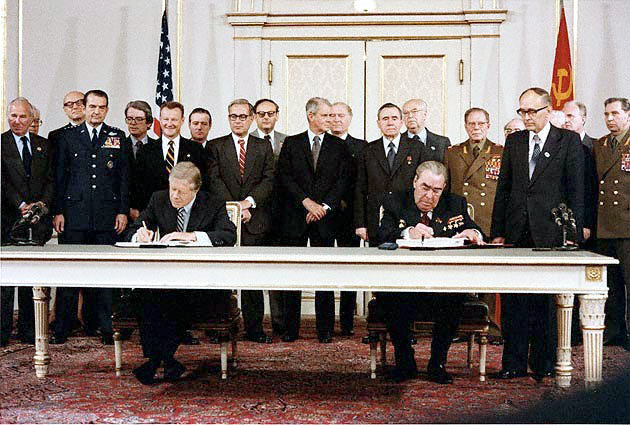
SALT comprised two distinct rounds, commonly referred to as SALT I and SALT II. SALT I culminated in the 1972 Anti-Ballistic Missile (ABM) Treaty and an interim agreement that limited the deployment of strategic ballistic missile launchers. The ABM Treaty constrained nationwide defensive systems to reduce incentives for a first strike and to preserve deterrence stability. SALT II, negotiated through the 1970s and signed in 1979, sought more comprehensive limits on offensive strategic systems, including delivery vehicles and multiple independently targetable reentry vehicles (MIRVs). Although SALT II was never ratified by the United States Senate, many of its provisions influenced subsequent behavior and later treaties.
Negotiation process and verification
Formal talks began in Helsinki in November 1969 and moved through several capitals and working groups over the following decade. Negotiators relied on a mix of diplomatic channels, technical exchanges, and emerging verification methods. Both sides depended heavily on national technical means—satellite reconnaissance, electronic intelligence, and open-source observation—to monitor compliance, since intrusive on-site inspections were constrained. The SALT process helped to develop routines and confidence-building measures that informed future arms-control regimes.
Historical context and outcomes
The SALT negotiations took place during a period of alternating engagement and confrontation between the two blocs. SALT I is widely regarded as a landmark because it produced a binding ABM Treaty and a framework arresting some quantitative competition. SALT II reflected deeper efforts to cap offensive capabilities, but its legal standing was compromised after the Soviet invasion of Afghanistan in 1979; in response the United States withheld Senate ratification. Nonetheless, both governments informally observed many of SALT II's limitations for several years, and the talks paved the way for later agreements such as START.
Importance, limitations, and legacy
SALT introduced the practice of negotiated ceilings on strategic forces and formalized verification as a central feature of arms control. Its successes included establishing legal constraints on defensive systems and setting precedents for parity-based limits. Limitations included vagueness in some technical definitions, difficulties in verifying mobile or clandestine platforms, and the political risk that external events could derail ratification and implementation. The SALT experience influenced subsequent treaties and remains a key episode in 20th-century efforts to manage nuclear competition.
Notable facts and distinctions
- SALT I (early 1970s) produced the ABM Treaty and an interim offensive-limiter agreement.
- SALT II was negotiated throughout the 1970s and signed in 1979 but was not ratified by the U.S. Senate; many of its provisions were nevertheless observed in practice.
- The talks advanced verification practices based on national technical means and diplomatic channels rather than intrusive inspections.
- SALT laid conceptual groundwork for later agreements such as START and other arms-control initiatives.
For more contextual background and primary documents, consult materials associated with both signatory states and contemporary analyses of détente and arms control. See also discussions of nuclear strategy and verification practices in the same period. Additional references: superpowers, Helsinki, and archival sources cited by governments and independent scholars.
Author
AlegsaOnline.com Strategic Arms Limitation Talks (SALT): overview, agreements, and legacy Leandro Alegsa
URL: https://en.alegsaonline.com/art/146215