
Riksdag — The Parliament of Sweden
The Riksdag is Sweden's national legislature. Unicameral since 1971, it has 349 members, meets in Stockholm and is responsible for legislation, budgets, government formation and scrutiny.
The Riksdag is the national legislature of Sweden, commonly referred to in Swedish as Sveriges riksdag. It is the country’s supreme decision‑making assembly for lawmaking and public finance. Members debate and adopt legislation, decide the national budget and exercise parliamentary control over the government.
Since 1971 the Riksdag has been a single‑chamber (unicameral) body. It currently has 349 seats, a number in place since 1976 (the assembly had 350 seats for a short period in the early 1970s). Members are elected by proportional representation in nationwide elections held every four years in September. Political representation is determined by a party‑list system with a commonly used parliamentary threshold to limit fragmentation.
The Riksdag sits in central Stockholm, on the island of Helgeandsholmen, in the historic parliament building. That complex houses plenary chambers, committee rooms and offices for members and staff. Plenary sittings, committee meetings and documents are made widely accessible to the public; in recent decades proceedings have also been broadcast and published online to promote transparency.
Image gallery
10 Images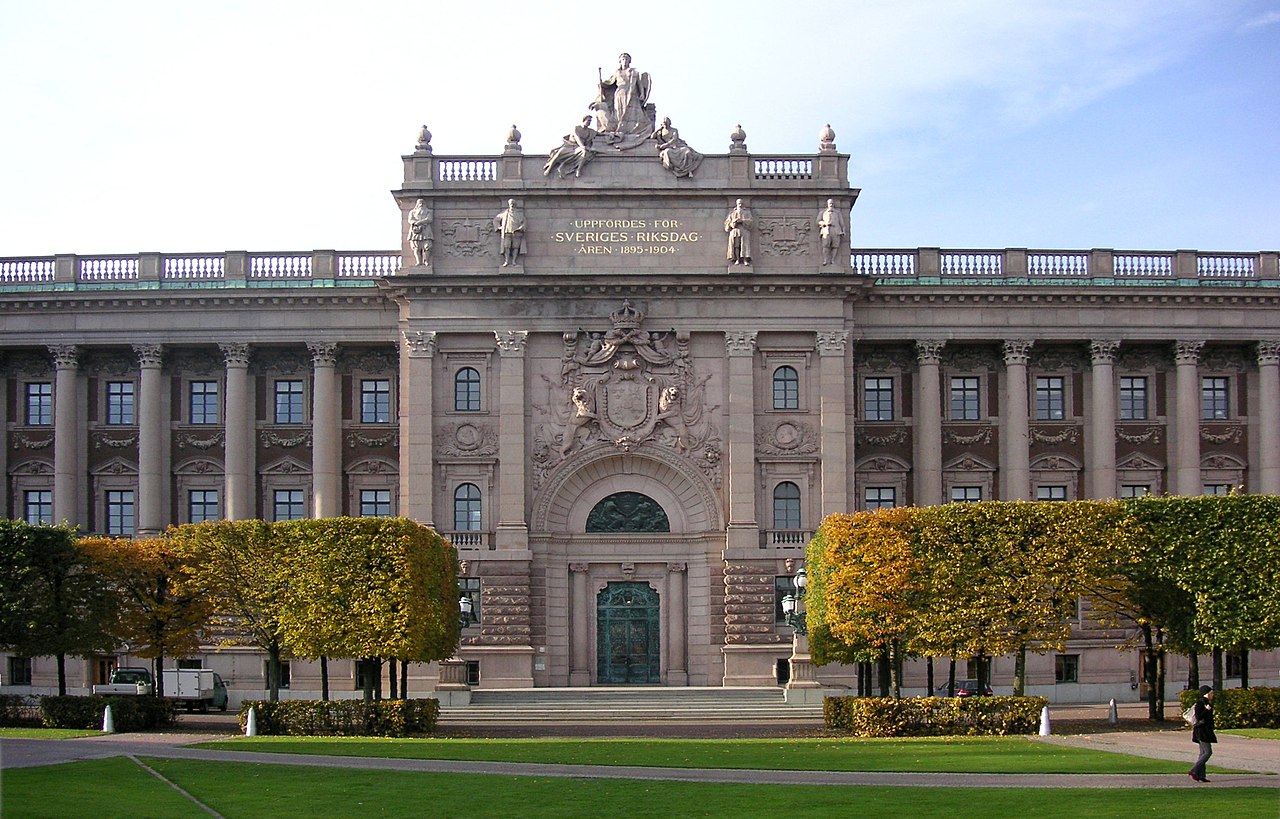


Key features
- Legislative authority: passes statutes and amends laws within the limits of the constitution and Sweden’s fundamental laws.
- Budget power: adopts the state budget and oversees public spending proposals from the government.
- Government formation and control: the Riksdag endorses the prime ministerial candidate, holds votes of confidence and conducts scrutiny through questions and investigations.
- Committee work: much of the detailed legislative and oversight work is carried out in specialized parliamentary committees before matters reach the full assembly.
The modern Riksdag evolved over centuries. Earlier assemblies represented estates and regional interests; a major reform in the 19th century created a bicameral parliament, which itself was replaced by the present unicameral system in 1971 as part of wider constitutional modernization. Today the Riksdag’s powers and procedures are grounded in Sweden’s constitutional framework, notably the Instrument of Government and other fundamental laws that define how power is shared and limited.
Practically, the Riksdag functions in a political culture marked by coalition building, negotiated compromises and a strong emphasis on committee deliberation. It plays a central role in shaping public policy, holding the executive to account, and representing citizens’ interests in national decision making. For further official information and public resources about the Riksdag’s work and schedules, see the institution’s own publications and online material.
Author
AlegsaOnline.com Riksdag — The Parliament of Sweden Leandro Alegsa
URL: https://en.alegsaonline.com/art/144860