
British Rail Class 120
A first-generation British diesel multiple unit built at Swindon Works from the late 1950s for cross‑country regional services; later replaced by more modern DMUs and partly preserved.
Overview
The British Rail Class 120 refers to a family of first‑generation diesel multiple units (DMUs) introduced for cross‑country and regional duties. The first examples appeared in 1958 and were constructed at the nationalised railway works in Swindon. These units were part of British Rail’s programme to replace steam traction on non‑electrified routes and to provide faster, more flexible regional services.
Image gallery
2 Images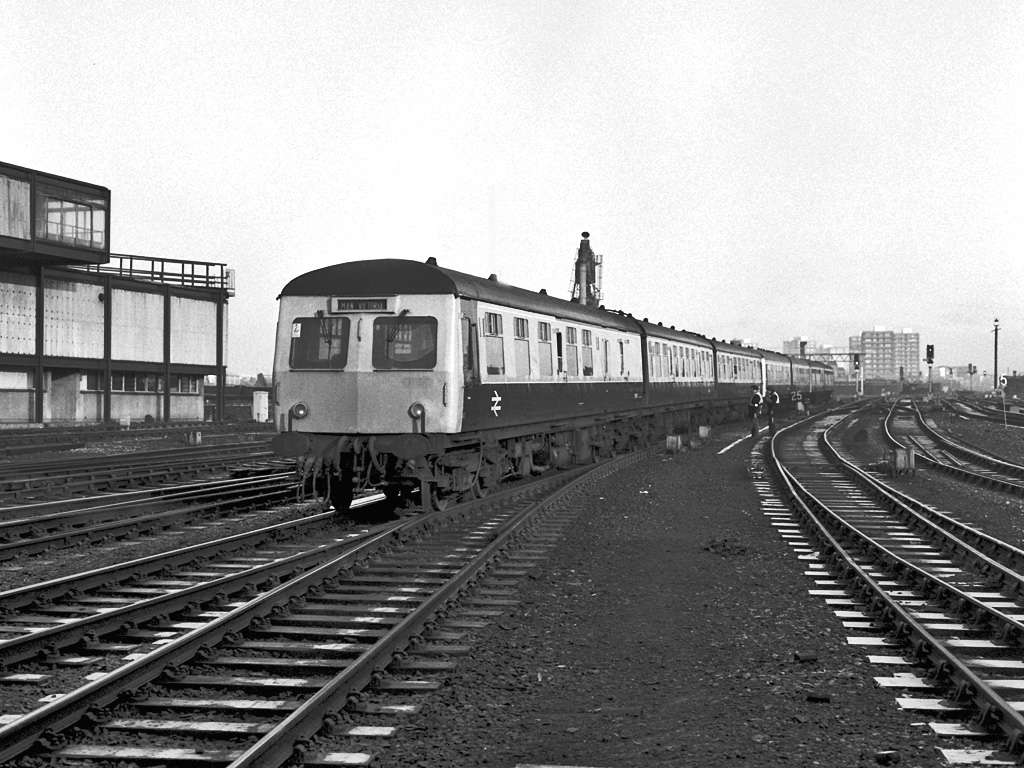

Design and characteristics
Class 120 units were conceived for longer regional runs rather than short commuter hops. They were commonly formed as multiple‑car sets to provide seated accommodation and baggage space for cross‑country travel. Typical features included steel bodywork, inter‑car gangways or connections useful for through travel, and a layout intended to balance passenger capacity with luggage and crew facilities.
- Era: late 1950s, early generation of DMUs
- Role: regional/cross‑country services on non‑electrified lines
- Construction: built at the railway’s Swindon works
- Formation: usually multiple‑car sets designed for longer runs
Service history
Introduced during the transition from steam to diesel, Class 120s operated on a variety of regional routes where electrification was absent. They offered improved acceleration, quicker turnarounds and simplified crewing compared with steam trains, helping reshape regional timetables. Over time newer generations of DMUs and multiple‑unit designs superseded these early examples, and the Class 120s were progressively withdrawn from mainline service as fleets were modernised.
Legacy and preservation
Although no longer a common sight on the national network, the Class 120s are notable as representative examples of British Rail’s first wave of diesel multiple units. Their construction at the historic Swindon Works links them to a long tradition of British railway manufacturing. A number of vehicles from early DMU classes have found their way into preservation, where they illustrate the engineering and operational changes of mid‑20th century British railways.
For those researching British first‑generation DMUs, the Class 120 provides a useful case study in how operators adapted rolling stock design to meet cross‑country service needs in the immediate post‑steam era.
Related articles
Author
AlegsaOnline.com British Rail Class 120 Leandro Alegsa
URL: https://en.alegsaonline.com/art/14327