
Mr. Deeds (2002 film)
2002 romantic-comedy remake starring Adam Sandler and Winona Ryder, directed by Steven Brill; a modern, comic retelling of Frank Capra's 1936 Mr. Deeds Goes to Town.
Overview
Mr. Deeds is a 2002 American comedy feature that reimagines a classic Depression-era story for contemporary audiences. The film stars Adam Sandler as a hospitable small-town man who unexpectedly inherits a great fortune and is thrust into the glare of New York City publicity. It blends romantic-comedy conventions with satirical takes on media and wealth.
Image gallery
1 Image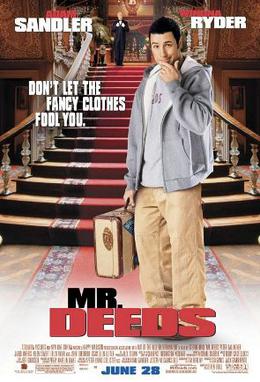
Plot and principal characters
The narrative follows a kindhearted everyman who leaves his quiet community after learning he has become immensely wealthy. In the city he meets a skeptical reporter who initially intends to expose him, but the pair grow closer as misunderstandings and schemes unfold. The leads are supported by an ensemble of character actors who populate the worlds of the small town and metropolitan high finance.
Production and release
The film was directed by Steven Brill and produced by Sid Ganis and Jack Giarraputo. Released in late June 2002, it was positioned as a mainstream summer comedy and marketed toward fans of its star and broad family-oriented audiences. Its roots as a retelling are acknowledged in promotional material and interviews.
Connection to the original and themes
This movie is a contemporary remake of the 1936 Frank Capra picture Mr. Deeds Goes to Town, adapted to fit modern humor and sensibilities. Where the original emphasized civic virtue and populist politics, the remake focuses more on personality clashes, media intrusion, and romantic development, updating the tone while preserving the core premise.
Reception and legacy
Critics offered mixed reactions: some praised the lead for his likability and the film's lighthearted moments, while others found the remake less sharp than the source. The movie remains of interest to those who study film remakes and popular comedy in the early 21st century.
Further context
- Genre: contemporary romantic/comedic remake — see broader comedy examples at comedy film.
- Main talent: led by a well-known comic actor with a notable co-star and supporting ensemble.
- Comparative note: the production illustrates how classic narratives are reshaped to reflect changing social and media landscapes.
Author
AlegsaOnline.com Mr. Deeds (2002 film) Leandro Alegsa
URL: https://en.alegsaonline.com/art/143045
Sources
- boxofficemojo.com : "Mr. Deeds"
- rottentomatoes.com : "Mr. Deeds"
- imdb.com : "Mr. Deeds - Awards"