
Monkey Business (1952 film)
A 1952 Howard Hawks comedy about a scientist's accidental discovery of a youth-restoring formula; a screwball ensemble with Cary Grant, Ginger Rogers and Marilyn Monroe, released by 20th Century Fox.
Monkey Business is a 1952 American comedy directed by Howard Hawks and released by 20th Century Fox. The film uses broad farce and domestic satire to explore themes of age, adulthood and marital roles. Though often described as a light or madcap picture rather than one of Hawks's weightier works, it brought together an accomplished cast and became part of each lead actor's midcentury screen legacy.
Image gallery
2 Images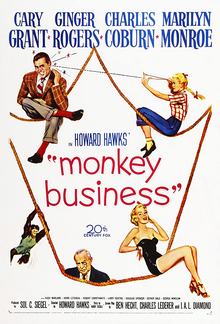
Premise and tone
The central conceit follows a scientific experiment that produces unexpectedly juvenile behavior in adults who ingest the formula. The narrative plays out as a series of escalating comic situations that upend workplace hierarchies and domestic routines. The mood combines elements of screwball comedy, slapstick and social satire common to Hollywood comedies of the late 1940s and early 1950s.
Principal cast and roles
- Cary Grant — leading man known for his comic timing and urbane persona.
- Ginger Rogers — the film's female lead with a strong background in both musical and dramatic roles.
- Marilyn Monroe — in an important supporting part that contributed to her growing screen profile.
- Hugh Marlowe — a member of the supporting ensemble.
- Additional supporting players include character actors who round out the company and domestic settings.
Rather than a serious scientific melodrama, the movie treats its premise as a vehicle for character-based comedy, verbal repartee and physical gags. The interactions between the married couple and their coworkers generate much of the humor, and the supporting cast helps maintain a brisk, farcical pace.
Production and reception
Produced and distributed by a major Hollywood studio, the film reflects studio-era craft values: economical plotting, established star personas, and production design suited to comedy. Contemporary reviews were mixed, with some critics enjoying the performances and situations while others preferred Hawks's earlier or later work. Over time the picture has attracted interest for its cast and for how it channels preoccupations about youth and conformity in postwar America.
Notable facts: the title plays on a familiar idiom rather than referring to literal animals; Marilyn Monroe's participation is often noted by film historians as part of her early rise; and the film is an example of how mainstream comedies of the period combined topical concerns with broad entertainment. For further reading on the director and principal performers, see entries on Howard Hawks, Cary Grant, Ginger Rogers, Marilyn Monroe and Hugh Marlowe.
Author
AlegsaOnline.com Monkey Business (1952 film) Leandro Alegsa
URL: https://en.alegsaonline.com/art/142825