
Mars 2020: Perseverance Rover and Ingenuity Helicopter Mission
NASA's Mars 2020 mission sent the Perseverance rover and Ingenuity helicopter to Jezero Crater to search for signs of past life, collect samples, and test new technologies for future exploration.
Overview
Mars 2020 is a NASA mission within the Mars Exploration Program that delivered the Perseverance rover and the small Ingenuity helicopter to the surface of Mars. Launched on 30 July 2020 and landed in Jezero Crater on 18 February 2021, the mission combines astrobiology goals with demonstrations of technologies intended to enable future human and robotic exploration. It builds on decades of Mars missions and continues broad scientific exploration of the planet.
Image gallery
10 Images



Spacecraft and principal components
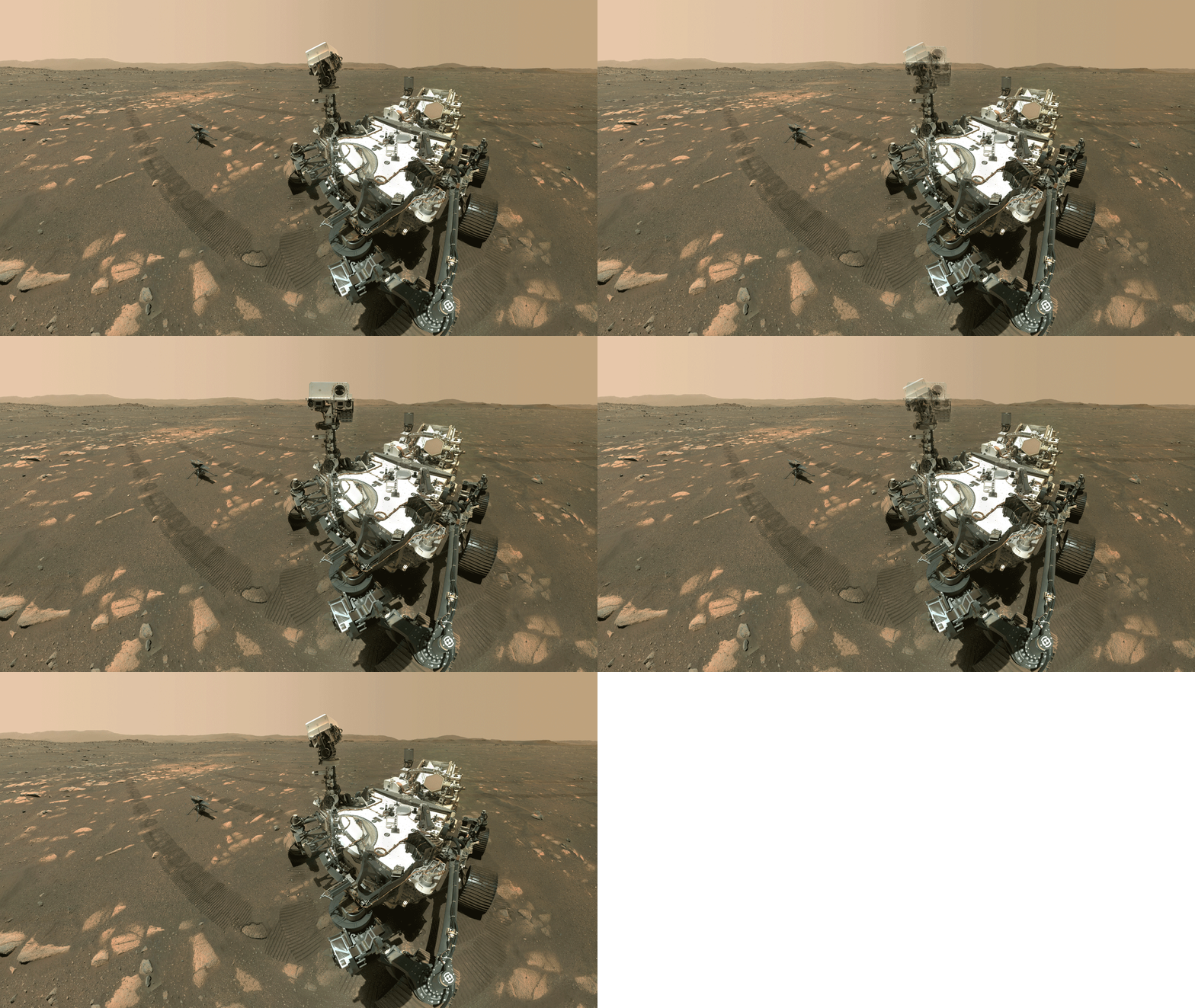
The mission's primary surface asset is the Perseverance rover, a mobile laboratory equipped to analyze rocks, soil, and atmosphere. Key elements include a sample caching system designed to collect and seal rock and regolith samples for possible future return to Earth; a suite of scientific instruments for imaging, spectroscopy, and environmental monitoring; and avionics for navigation and communication. Accompanying Perseverance is Ingenuity, a small autonomous rotorcraft flown as a technology demonstrator to explore powered flight in the thin Martian atmosphere.
Notable instruments and systems
- Remote imaging and chemistry: cameras and spectrometers to identify minerals and textures.
- Close-up analysis: instruments that examine rock fine structure and elemental composition.
- Atmospheric experiments: sensors to measure weather and the atmospheric composition, including a technology demonstrator that produces oxygen from carbon dioxide.
- Sample caching: tools to drill, collect, and seal samples for potential return to Earth by a later mission.
Scientific goals and importance
Primary scientific aims are to search for signs of ancient microbial life by studying sediments and rocks that once hosted water; to characterize the planet's geology and climate; and to collect and preserve samples that could be returned to laboratories on Earth. The mission helps address fundamental questions about whether Mars ever supported habitable conditions and informs assessments of long-term planetary evolution.
Mission timeline and milestones
Mars 2020 launched in July 2020 and accomplished a successful atmospheric entry, descent, and landing (EDL) in February 2021 using an updated cruise stage, heatshield, parachute, and sky crane system. After landing, Perseverance deployed instruments, began geologic surveys, and started filling its sample cache. Ingenuity achieved the first sustained powered flights on another planet, validating technologies that could enable aerial scouting on future missions. For official mission details see the mission overview and the program page.
Technology demonstration, legacy, and future plans
Ingenuity proved that powered, controlled flight in Mars' thin atmosphere is feasible, opening new reconnaissance possibilities. Other technologies on Mars 2020, such as in-situ oxygen production experiments, inform concepts for human exploration. The sample caching campaign is a cornerstone for an envisioned multi-mission effort to return Martian samples to Earth. For updates, technical results, and outreach resources see project reports and mission updates.
Overall, Mars 2020 advances both scientific discovery and engineering capabilities, linking robotic exploration with future sample return and human missions while improving our understanding of Mars as a former or potential habitat.
Author
AlegsaOnline.com Mars 2020: Perseverance Rover and Ingenuity Helicopter Mission Leandro Alegsa
URL: https://en.alegsaonline.com/art/142298