
House of Cards (1968 film)
1968 American crime-mystery film directed by John Guillermin, adapted from the Stanley Ellin novel, starring George Peppard, Inger Stevens and Orson Welles; a late-60s noir-influenced thriller.
Overview
House of Cards is a 1968 American crime-mystery motion picture directed by John Guillermin and released by Universal Pictures. The screenplay adapts the novel by Stanley Ellin and presents a layered, suspense-driven narrative typical of mid-20th-century mystery fiction. The film is often noted for its cast, which includes George Peppard, Inger Stevens and Orson Welles, among others.
Image gallery
1 Image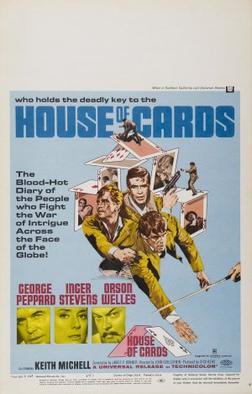
Plot sketch and style
The story revolves around a central crime and the subsequent investigation that reveals hidden relationships, motives and deceptions. Rather than presenting a straight procedural, the film emphasizes character dynamics and moral ambiguity: loyalties shift, alibis are questioned, and the truth emerges through a sequence of interviews, confrontations and revelations. Stylistically, the picture borrows elements from film noir and psychological thrillers of the era, using atmosphere and performance to build tension more than action set pieces.
Cast and characters
The ensemble cast blends established screen personalities and character actors. Principal performers include:
- George Peppard — a leading man of the period whose presence anchors much of the film's dramatic weight.
- Inger Stevens — in one of her later screen roles, contributing a key emotional center.
- Orson Welles — offering a strong supporting turn that draws attention even in a non-leading part.
- Maxine Audley, Keith Michell, Peter Bayliss and Patience Collier — notable character performers who fill out the network of suspects and witnesses.
Production and adaptation
The film was adapted from Stanley Ellin's novel; the screenplay condenses literary detail to fit cinematic pacing while aiming to retain the novel's core puzzle and psychological undercurrents. Director John Guillermin, known for his work across genres, focused on clear, taut storytelling and relied on strong performances to convey subtext. Universal Pictures handled distribution, situating the picture in the late-1960s market for adult-oriented mysteries.
Reception and significance
Upon release the film received mixed reviews, with critics divided over the faithfulness and effectiveness of the adaptation and the balance between character study and plot mechanics. Many commentators praised the performances and the film's moody atmosphere, while some found the pacing deliberate. In historical perspective, the movie is remembered as part of a broader trend toward psychologically complex thrillers in the 1960s and as an example of Ellin's influence on screen adaptations of crime fiction.
Notable facts and distinctions
House of Cards stands out for its distinguished cast and for being a literary adaptation of a respected mystery author. While not as widely known as some contemporary thrillers, it remains of interest to students of genre cinema and fans of the principal actors. For further reading on the director and principal performers see entries on John Guillermin, George Peppard, Inger Stevens, Orson Welles and Keith Michell.
Author
AlegsaOnline.com House of Cards (1968 film) Leandro Alegsa
URL: https://en.alegsaonline.com/art/139858