
Herschelian telescope
A late 18th‑century single‑mirror reflector devised by William Herschel that tilted the primary to place the eyepiece at the front, avoiding a secondary mirror and compensating for low mirror reflectivity of the era.
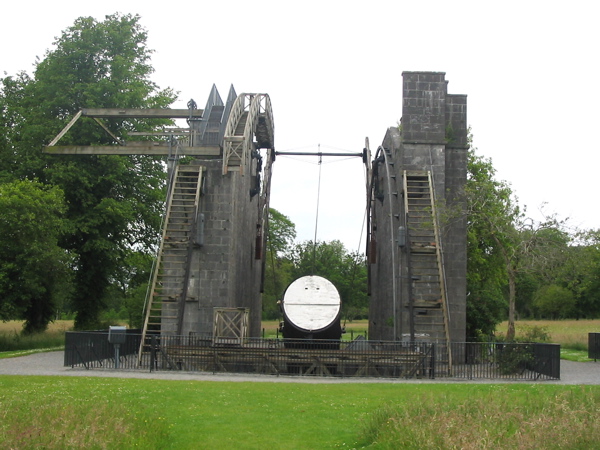
The Herschelian telescope is a type of reflecting telescope developed in the late 18th century by William Herschel. It resembles a Newtonian telescope in using a single primary mirror, but departs from that design by tilting the primary mirror so the focal point falls near the rim of the instrument. This arrangement removes the need for a separate secondary mirror, moving the eyepiece to a position at or near the front of the tube.
Image gallery
10 Images




Design and optical characteristics
In the Herschelian layout the primary mirror is set at a slight angle to the incoming light. That tilt directs the converging beam off the central axis and out to an accessible viewing position. Key features include:
- Only one mirror in the optical path — no secondary mirror to reflect light a second time.
- Front‑mounted eyepiece, which can make privileged viewing positions possible on some mounts.
- An off‑axis beam that introduces optical aberrations such as coma and astigmatism when compared with on‑axis reflectors.
Historical context and development
Herschel adopted this approach when mirrors were made from polished metal alloys that reflected a relatively small fraction of incident light and degraded with tarnish. By eliminating a secondary surface he reduced the number of reflections, preserving image brightness. Herschel used large metal‑mirror reflectors of his own construction for deep‑sky observing and surveys during a period of rapid growth in observational astronomy.
Uses, advantages and limitations
The principal advantage of the Herschelian form was higher throughput with the poorly reflective mirrors available at the time, and a simpler optical train. Its disadvantages included increased off‑axis aberrations due to the tilted primary, and practical awkwardness: the eyepiece can block part of the aperture and the tilt complicates fabrication and alignment. As mirror‑coating technology improved — first with silvering, later with durable aluminum coatings — the light loss from adding a secondary mirror became negligible, and alternative designs (Newtonian, Cassegrain, Gregorian) regained favor.
Legacy and distinctions
Today the Herschelian telescope is historically important as an adaptive solution to material limits of its era and as part of William Herschel's broader contributions to observational astronomy. It is rarely used in modern practice except in historical demonstrations or some niche amateur reproductions. For comparisons with other reflector types see entries on the Newtonian telescope and other classical layouts; for the mirror technology that motivated the design see speculum metal. The basic concept — tilting a primary to avoid a secondary — remains a clear example of form following available technology in instrument design, and is discussed in historical surveys of telescope development and literature on optical engineering.
Author
AlegsaOnline.com Herschelian telescope Leandro Alegsa
URL: https://en.alegsaonline.com/art/139673