
A Visit from St. Nicholas (commonly called 'The Night Before Christmas')
An encyclopedic article on the 1823 poem 'A Visit from St. Nicholas', its form, publication, disputed authorship, imagery of Santa and his reindeer, and its cultural impact.
A Visit from St. Nicholas, frequently cited by its opening line "'Twas the night before Christmas", is an influential short poem first printed anonymously in an American newspaper in 1823. Its vivid domestic scene, brisk narrative voice and memorable details helped to shape modern English-language ideas about a Christmas gift-bringer: a cheerful, round-bodied man who arrives on a sleigh pulled by eight named reindeer and leaves toys for children. The work is brief, written to be read aloud, and became widely known through repeated reprinting, recitation in family and public settings, and illustrated editions aimed at children. The poem's phrases and proper names — including the reindeer roster that still appears in popular culture — have entered general vocabulary and seasonal custom.
Image gallery
7 Images


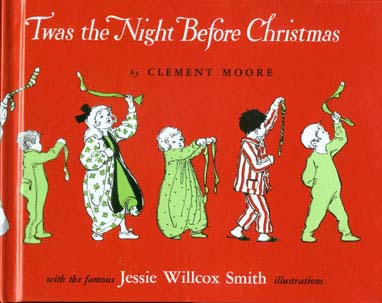
Form, language, and central images
The poem is written in anapestic tetrameter, a lively meter that lends itself to rapid narration and verbal music, and its tone balances gentle domesticity with comic surprise. It opens in a household at rest and proceeds through a swift, cinematic sequence: a sudden clatter, a look outside, the sight of a miniature sleigh and reindeer, the entrance down a chimney, a quick visit to fill stockings, and an equally rapid departure. The poem's concrete sensory details — the moonlit snow, the scent of soot, the twinkling eyes and rosy cheeks of the visitor — create an intimate portrait. The character's physical description emphasizes a small, friendly stature, a round belly that "shook like a bowl full of jelly," and a white beard, all of which have helped standardize later visual portrayals.
Names, features, and notable lines
One of the poem's most durable contributions is the naming of the eight reindeer and the depiction of a sleigh as the vehicle for delivering toys. The reindeer are called out in a rapid list that has been preserved, adapted and quoted for nearly two centuries. Their names appear repeatedly in later retellings and seasonal media, and the rallying cry used to send them onward has become a familiar festive refrain. Short, evocative lines from the poem are frequently extracted in greeting cards, children's anthologies, and holiday programs because they combine rhythm, clear imagery and good memorability.
Publication history and authorship
The poem was first printed anonymously on December 23, 1823, in the Troy Sentinel, a small upstate New York newspaper; modern editions and reference works often note that initial newspaper appearance as the poem's public debut. In subsequent years the poem circulated widely in newspapers and pamphlets. In 1837, the poem began to be commonly attributed to Clement Clarke Moore after he included it in an anthology of his poems; since then, his name has been associated with the piece in many bibliographies and editions. However, authorship has been questioned: descendants of another writer, Henry Livingston Jr., and some later scholars have argued for a different origin, and the question of definitive authorship remains a topic of literary and historical discussion rather than settled fact. For the original publication and early circulation, see contemporary reports and reprints in historical newspaper collections: first printing and accounts of its appearance in 1823.
Influence, adaptations, and cultural role
Over the nineteenth and twentieth centuries the poem contributed to a growing, composite Anglo-American image of a Christmas gift-giver that fused folk traditions, European influences and new popular elements. Illustrators and storytellers repeatedly drew on the poem's defining features — chimney entry, stockings, a sleigh with reindeer, and the visitor's Merry persona — when creating picture books, children's plays, newspaper features and holiday advertising. While many later commercial images and campaigns refined or altered the character's appearance, the poem remains a touchstone in discussions of how the familiar modern figure was assembled. Its lines and scenes continue to be adapted in radio and television programs, children’s theatre, and seasonal readings, and references to the work often appear when popular culture revisits or parodies traditional Christmas motifs. For general background on the poem's role in shaping the modern Santa image, see summaries and analyses that treat the poem alongside other influential sources on Santa Claus.
Legacy, variation, and scholarly note
Critical attention has ranged from gentle commentary on its poetic technique to more detailed scholarly study of its publication history, circulation and cultural consequences. Editions of the poem show minor textual variations that reflect typesetting practices, dialect transcription and later editorial choices; one well-known textual variant alters the spelling of one reindeer's name. The piece's adaptability — its ability to be read to children, printed in newspapers, or illustrated for a marketplace — has helped maintain its presence in holiday culture. Today's readers encounter the poem in anthologies, online resources, staged readings and family traditions; it stands as a prominent example of how a single short composition can exert wide and lasting influence on social customs, seasonal imagery and the popular imagination.
- Core contributions: vivid domestic detail, named reindeer, chimney tradition, cheerful visiting figure.
- Meter and style: lively anapestic tetrameter suitable for oral performance.
- Publication: anonymous newspaper appearance in 1823; later attributed to Clement Clarke Moore.
- Continuing relevance: regularly reprinted, adapted and cited in cultural depictions of Christmas.
Author
AlegsaOnline.com A Visit from St. Nicholas (commonly called 'The Night Before Christmas') Leandro Alegsa
URL: https://en.alegsaonline.com/art/134858