
Awadhi language
Awadhi is an Indo-Aryan language of northern India with a long literary and oral tradition, historically used across the Awadh region and influential in the development of modern Hindi.
Overview
Awadhi is an Indo-Aryan language traditionally spoken in the Awadh region of northern India. It belongs to the broader group of Hindi languages and has been used for everyday communication, folk performance, and devotional literature. The language has a long oral history and a recorded literary presence that reaches back several centuries.
Image gallery
6 Images


Linguistic characteristics
Awadhi shares many features typical of Indo-Aryan languages: subject–object–verb word order, a system of nominal gender and grammatical agreement, and a rich set of verb forms that mark tense, aspect and mood. It uses postpositions rather than prepositions and relies heavily on participles and auxiliary verbs to form periphrastic tenses. Phonologically, Awadhi preserves a set of retroflex consonants and vowel contrasts characteristic of the region.
Geographic distribution and scripts
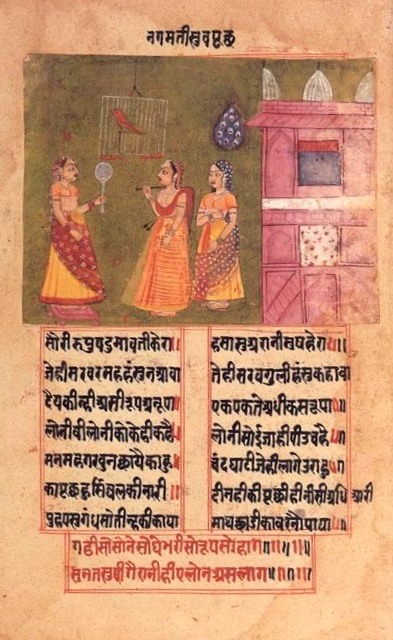
The traditional speaking area centers on the historic Awadh plain, including cities such as Lucknow and Ayodhya. Rural speech varieties remain strong in villages, while urban use has declined where standardized education and media favor Modern Standard Hindi. Historically, Awadhi was written in regional scripts like Kaithi and later in Devanagari; manuscript traditions and inscriptions show variability in writing practices across communities.
History and literature
Awadhi has a notable literary record. The most famous work in the language is the epic devotional poem Ramcharitmanas by Goswami Tulsidas, composed in the 16th century, which remains widely read and performed. Beyond high literature, Awadhi has produced a wealth of folk songs, ballads, seasonal songs and oral epics that form a living cultural archive.
Uses, varieties and contemporary status
Awadhi exists as a continuum of local dialects rather than a single uniform standard. Some varieties are mutually intelligible with neighboring Eastern Hindi dialects, while others show distinctive vocabulary and pronunciation. In modern times, the influence of Modern Standard Hindi—whose development drew on several regional literary dialects including Awadhi and Braj—has affected vocabulary and prestige. For an overview of that relationship see Modern Standard Hindi.
Notable facts and preservation
- Awadhi has both literary and strong oral traditions that continue in music and religious recitation.
- Debate continues over classification: some treat it as a distinct language, others as a Hindi dialect.
- Contemporary efforts in scholarship and local media seek to document dialectal diversity and preserve folk genres.
Understanding Awadhi involves both its historical texts and the everyday speech of communities that keep the language alive. Its cultural imprint—especially through devotional and folk forms—remains significant in northern India.
Author
AlegsaOnline.com Awadhi language Leandro Alegsa
URL: https://en.alegsaonline.com/art/134833