
Arnold Spielberg
Arnold Spielberg (1917–2020) was an American electrical engineer whose early work on real-time data acquisition, control systems and commercial computing influenced industrial automation and point-of-sale technology.
Overview
Arnold Meyer Spielberg (February 6, 1917 – August 25, 2020) was an American electrical engineer known for early advances in real-time data acquisition, control systems and practical computer design. Working in the mid-20th century, he helped adapt electronic and digital techniques so that machines could record, respond to and control physical events as they happened. He was also the father of film director Steven Spielberg.
Image gallery
1 Image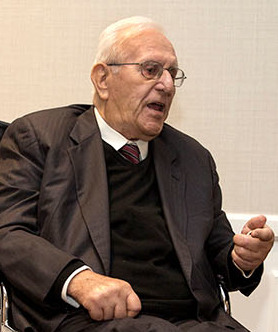
Early life and interests
Born in 1917, Spielberg grew up in an era when radio, vacuum tubes and later transistors transformed the possibilities of electronics. His family background included Jewish ancestry, and he developed practical skills and an interest in engineering that led to a career building devices and systems rather than producing purely theoretical research. Throughout his life he combined hands-on design, systems thinking and an interest in how electronic instruments could be applied in business and industry.
Career and technical contributions
Spielberg worked on projects that advanced the capture and processing of data in real time. These efforts addressed a central problem of early computing: how to sense events in the physical world and make them available to electronic systems without long delays. His work contributed to approaches for feedback and control that later became common in industrial automation, instrumentation and computing-based control loops.
GE-225 and commercial computing
At General Electric and in related industry positions, Spielberg participated in the design and engineering of early commercial computer systems. One machine often associated with his work is the GE-225, introduced in the late 1950s and used in various research and business contexts. The GE-225 and similar mid-century computers are frequently cited in histories of commercial computing because they helped bridge laboratory prototypes and systems intended for practical, interactive use, including time-sharing and interactive computing research.
Point-of-sale innovation and real-time systems
Spielberg described one of his most concrete contributions as designing an early computer-controlled point-of-sale cash register. Implementations of this type showed how sensors, timing mechanisms and recording devices could be combined with digital logic to capture transactions and produce reliable records, anticipating many features of modern retail and inventory systems. His focus was often on reliability, immediate data capture and straightforward integration with mechanical and electronic peripherals.
Methods and engineering approach
Throughout his career, Spielberg emphasized practical engineering methods: selecting components and architectures that delivered dependable operation, designing interfaces between analog sensors and digital circuits, and ensuring that systems could perform under continuous, real-world conditions. His work illustrates how early computer engineering required not only theoretical knowledge but also mechanical insight, cabling and timing discipline, and attention to maintainability.
Legacy and recognition
Arnold Spielberg's contributions are remembered in accounts of how computing moved from experimental laboratories into factories, stores and offices. By improving ways to record and act on events as they occurred, his work influenced industrial control, instrumentation and commercial computer applications. Colleagues and historical summaries have highlighted his role in making real-time data acquisition and control more practical for business and industry.
Personal life and death
Spielberg lived to an advanced age and continued to be noted in media and retrospective accounts for his engineering career and for the home environment that encouraged curiosity and technical tinkering. He died at his home in Los Angeles on August 25, 2020, at the age of 103. His life spans a period in which electronics and computing transformed most areas of modern life.
Further reading
- Summaries of mid-20th century commercial computers and the transition to interactive systems often reference machines like the GE-225 and related engineering work.
- Biographical and retrospective articles provide context for his work in real-time systems and for his role as a practicing engineer rather than a purely academic researcher; see sources associated with historical computing archives and industry histories for more detail.
- Family and personal histories sometimes note the influence of a technically engaged household on later generations; for example, accounts of his family life appear alongside coverage of his son, Steven Spielberg.
For specific primary sources and technical descriptions, consult archival materials and histories of computing maintained by museums, libraries and professional organizations that document early work at companies such as General Electric and other industrial research groups. Additional biographical references discuss his ancestry and family background in broader context (Jewish heritage is sometimes mentioned in biographical notices).
Author
AlegsaOnline.com Arnold Spielberg Leandro Alegsa
URL: https://en.alegsaonline.com/art/134654