
William Phillips (economist)
William Phillips (1914–1975) was a New Zealand-born economist and LSE professor best known for the Phillips curve and for building the MONIAC hydraulic economic simulator.
William Phillips (Alban William Housego Phillips, 18 November 1914 – 4 March 1975) was a New Zealand-born economist who became a prominent academic at the London School of Economics. He is most widely remembered for identifying an empirical relationship between inflation and unemployment that later became known as the Phillips curve. His career combined practical, experimental approaches to modeling economies with influential theoretical observations that shaped postwar macroeconomic debate.
Image gallery
2 Images
Overview and significance
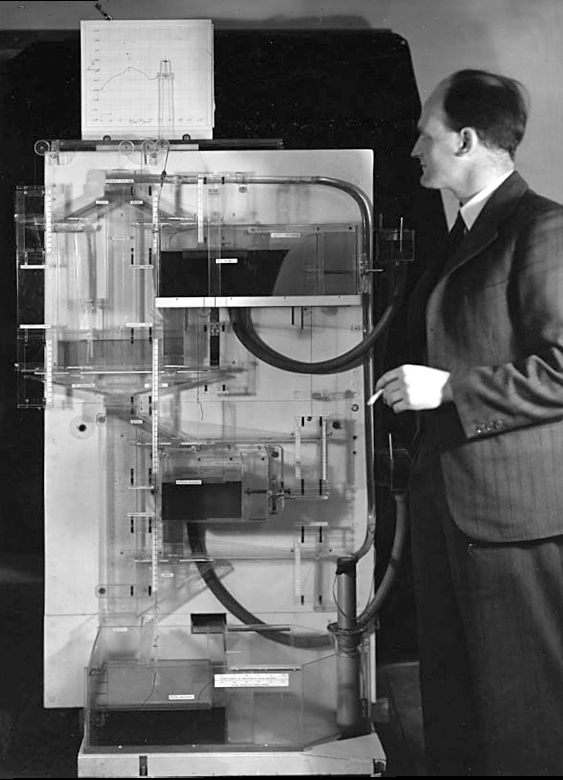
Phillips made two contributions that have endured in economic thought. The first, formulated in 1958, described a negative relationship between wage inflation and unemployment in the United Kingdom, suggesting a trade-off policymakers might face between price stability and labor-market slack. The second was a physical analog computing device called the MONIAC, which used flowing water to simulate economic flows and reveal how fiscal and monetary variables interact.
Major contributions
- Phillips curve: An empirical observation linking measures of inflation and unemployment. It stimulated extensive study of inflation dynamics, expectations, and policy choices within macroeconomics and public debate over trade-offs in stabilization policy. See also general discussions of economics.
- MONIAC hydraulic computer: An analog machine built in 1949 that represented national income flows by moving water through tanks and pipes. It served as a teaching tool and demonstration of system behavior under different policy settings.
- Academic role: Phillips served as a professor at the London School of Economics, where his empirical and experimental work influenced students and colleagues.
Context, reception and later debate
Initially, the Phillips curve was interpreted by some as indicating a stable policy choice between inflation and unemployment. During the 1960s it informed many macroeconomic policy discussions. However, later developments—most notably work emphasizing the role of expectations and the experience of high inflation with high unemployment (stagflation) in the 1970s—led economists to refine the original view. Critics argued that the simple empirical relationship did not hold as a policy menu once expectations and supply shocks were accounted for. These debates deepened understanding of inflation dynamics and influenced how central banks and governments approach stabilization.
Legacy and notable facts
Phillips was appointed MBE and is remembered both for the name that bears his work and for his inventive approach to modeling economic systems. His contributions exemplify how empirical observation and creative demonstration can provoke long-lasting theoretical development. For introductions to related topics, readers can follow links about inflation, unemployment, and broader issues in economic research and policy-making.
For further reading about his life and work consult academic histories of postwar macroeconomics and institutional accounts from the New Zealand and the economics departments that preserve his papers and discussions of the era. Archived materials at institutions such as the London School of Economics include examples of the MONIAC and contemporary responses to the Phillips curve.
Although later scholarship complicated the simple trade-off the Phillips curve once implied, Phillips's name remains central to teaching and research on inflation, labor markets, and the history of macroeconomic thought.
Author
AlegsaOnline.com William Phillips (economist) Leandro Alegsa
URL: https://en.alegsaonline.com/art/132970