
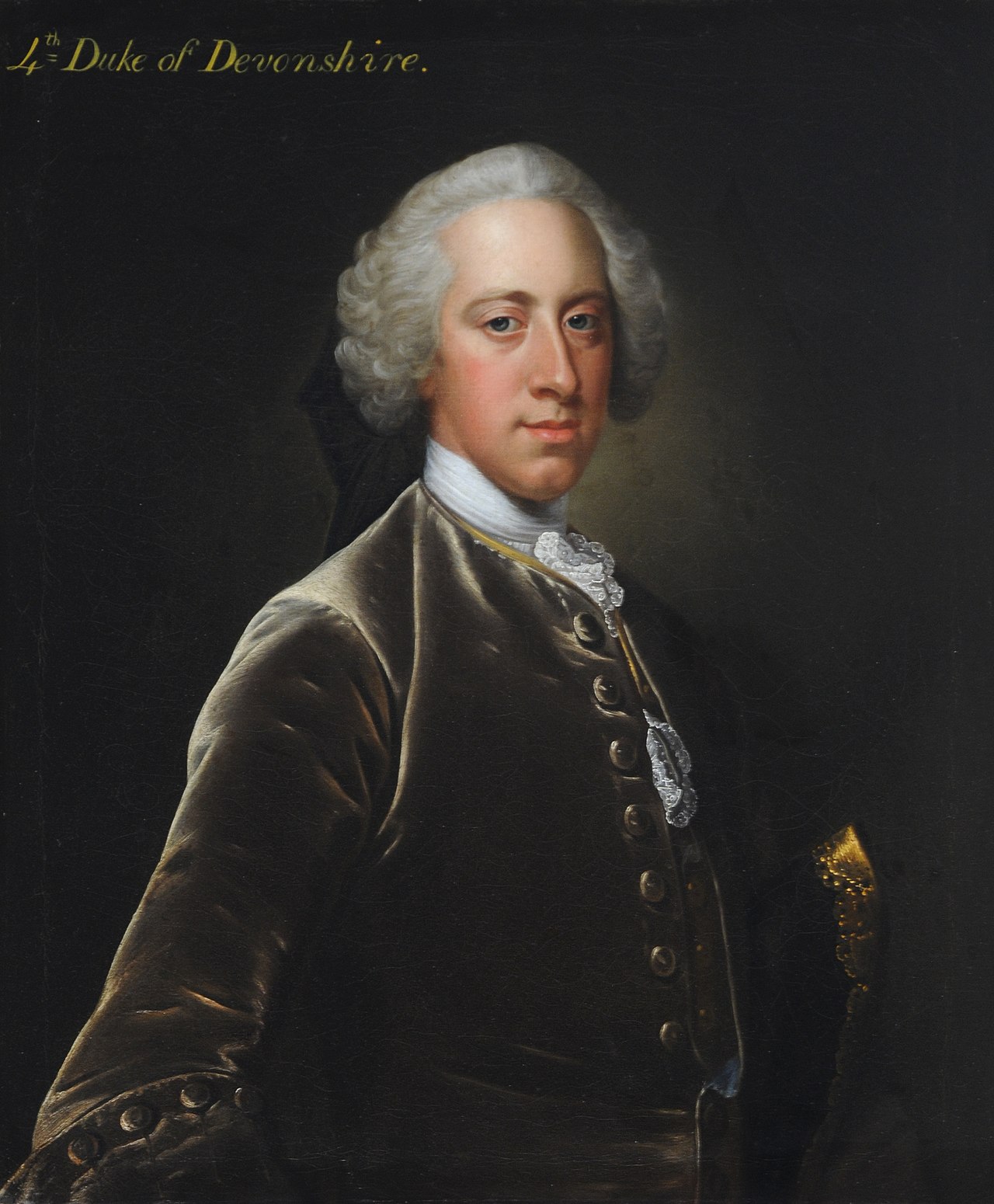
William Cavendish, 4th Duke of Devonshire
British Whig aristocrat and statesman (bapt. 1 June 1720 – 2 October 1764) who served briefly as Prime Minister of Great Britain during the crisis period of the Seven Years' War.
Overview
William Cavendish, 4th Duke of Devonshire, KG, PC (bapt. 1 June 1720 – 2 October 1764) was a leading English aristocrat and Whig politician of the mid-18th century. Best known for his short tenure as a government leader at the outset of the Seven Years' War, he is often remembered as a compromise figure whose ministry bridged competing political factions.
Image gallery
5 Images


Background and family
Cavendish belonged to the prominent Cavendish family, long associated with the Dukedom of Devonshire and estates such as Chatsworth. As a high-ranking peer he combined landed influence with the traditional Whig commitment to parliamentary government. He held the chivalric honour of Knight of the Garter and was a member of the Privy Council, reflecting his status at court and in national affairs.
Political career and offices
Although he did not dominate policy-making, Cavendish performed several senior ceremonial and political roles. His name appears in histories of the period as a Whig statesman who presided over a transitional administration. His premiership placed him formally at the head of the ministry while practical leadership was exercised by strong ministers of the day.
Premiership and historical context
During the international crisis of the mid-1750s, the government underwent rapid change. Cavendish was chosen as a unifying leader during the turbulent months when Britain confronted the early stages of the Seven Years' War. The arrangement reflected the need for a peer acceptable to different Whig factions and to the crown; prominent figures such as William Pitt provided energetic direction within the same government.
Legacy and significance
Historians view the 4th Duke of Devonshire as an example of an aristocratic statesman whose importance lay less in policy innovation than in holding together a fragile coalition at a critical moment. His brief administration helped clear the way for subsequent ministerial realignments that produced more durable wartime leadership. For general reference on his life and era see entries and sources linked below.
Further reading
Author
AlegsaOnline.com William Cavendish, 4th Duke of Devonshire Leandro Alegsa
URL: https://en.alegsaonline.com/art/132896