
Wilhelm Conrad Röntgen
German physicist who discovered X-rays in 1895 and received the first Nobel Prize in Physics (1901); his work launched diagnostic radiography and influenced 20th-century physics and medicine.
Wilhelm Conrad Röntgen (27 March 1845 – 10 February 1923) was a pioneering physicist born in Lennep, Germany. He is best known for the discovery of X-rays in 1895, an advance that immediately transformed scientific research and medical diagnosis. Röntgen's work combined careful laboratory experiment with clear reporting, and he became the first recipient of the Nobel Prize in Physics in 1901.
Image gallery
9 Images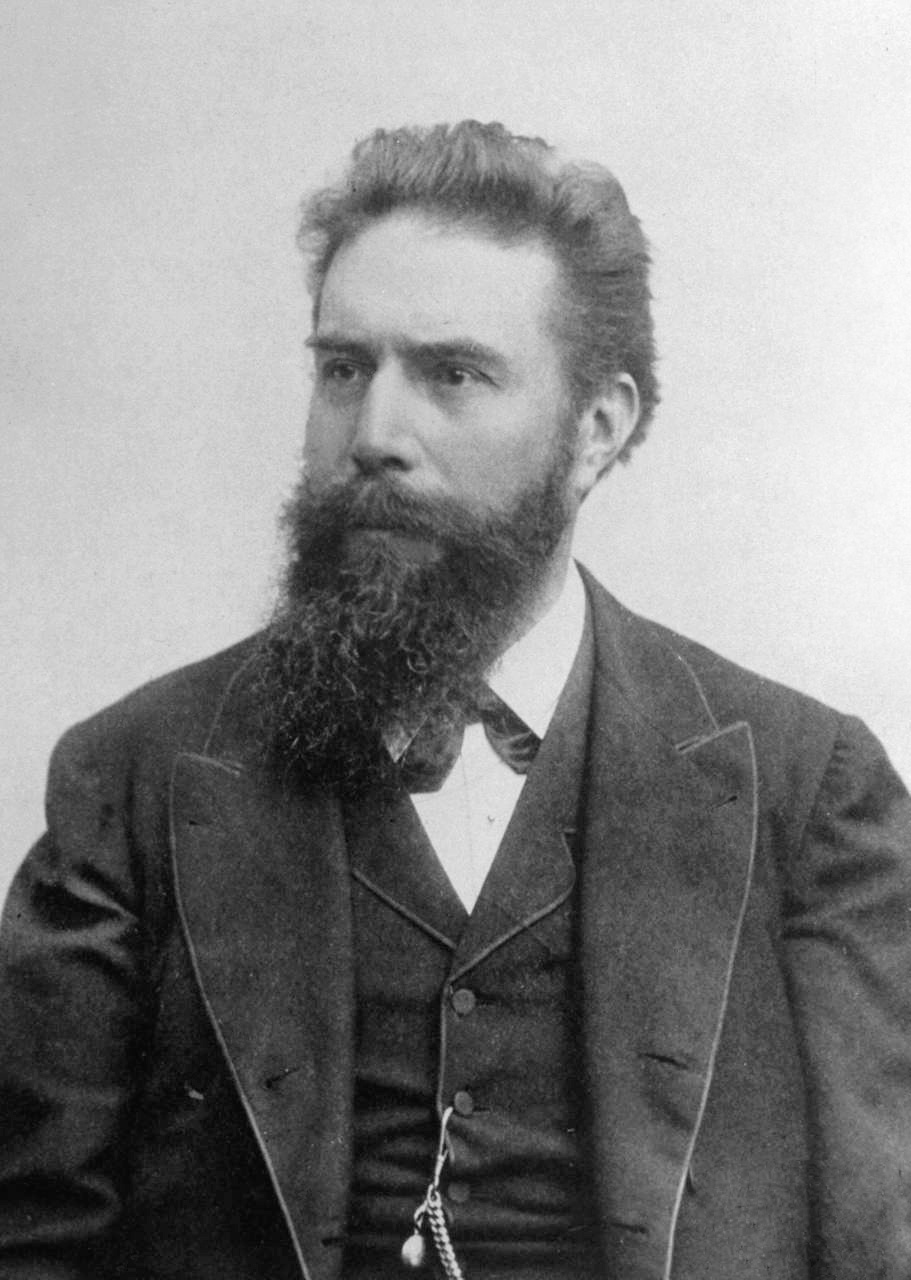


Life and career
Röntgen studied at technical and university institutions in the Netherlands and Switzerland before holding academic posts in Germany. He taught and conducted research at several universities, including positions that allowed him to pursue experimental studies of electrical discharges and cathode rays. His methodical approach and attention to detail were characteristic of his scientific career.
Discovery and experiments
In late 1895 Röntgen noticed that a fluorescent screen in his laboratory glowed when a nearby cathode ray tube was active, even though it was shielded from direct light. He investigated the phenomenon, showing that an unknown type of penetrating radiation was being produced. He called these emissions "X-rays" (using the algebraic symbol for the unknown) and documented their ability to pass through soft tissues while being absorbed by denser materials such as bone and metal. One of the earliest and most famous images he produced was of his wife's hand, which showed the bones and her wedding ring.
Uses and impact
The discovery quickly found practical applications. Within months physicians used X-rays to locate fractures and foreign objects inside the body, starting the field of diagnostic radiography. Röntgen chose not to patent his discovery, enabling rapid, widespread adoption. Beyond medicine, his discovery influenced research into atomic physics and paved the way for later advances in imaging and radiation science.
Notable facts and legacy
- Röntgen received the first Nobel Prize in Physics in 1901 for his discovery.
- The term for X-rays in many languages (for example, German) is derived from his name.
- He declined to patent the discovery so it could be freely used for the public benefit.
- His discovery remains a foundational milestone in both physics and medical diagnostics.
Röntgen died in Munich in 1923. His careful experimental records, clear communication of results, and the broad utility of the phenomenon he uncovered secure his place as one of the most influential experimental scientists of the late 19th century. For further reading on his life and work see general scientific biographies and historical treatments of early radiology.
Related terms: German scientific tradition, X-rays, medical imaging and early 20th-century physics.
Author
AlegsaOnline.com Wilhelm Conrad Röntgen Leandro Alegsa
URL: https://en.alegsaonline.com/art/132865