
Walter Hallstein: German jurist, diplomat and first President of the EEC Commission
Overview of Walter Hallstein (1901–1982), his role as a legal scholar, architect of European integration, first president of the EEC Commission and author of the Hallstein Doctrine.
Walter Hallstein (1901–1982) was a German legal scholar, diplomat and politician who became a central figure in post‑war European integration. Trained as a lawyer and academic, Hallstein combined scholarship with public service and is widely remembered for advancing supranational institutions in Western Europe. Early biographical summaries often describe him as an academic and statesman.
Image gallery
10 Images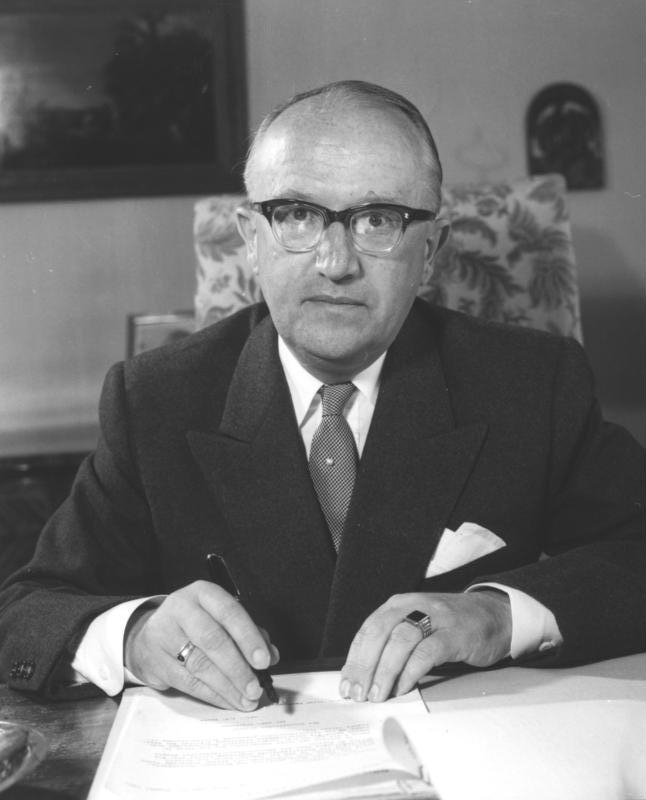



Major offices and contributions
Hallstein served as the first President of the Commission of the European Economic Community from 1958 to 1967, guiding the new executive body through its formative years and helping shape the Common Market's administrative structures. He played a prominent role in drafting policies and procedures that defined the Commission as a distinct European institution (Commission of the European Economic Community).
Hallstein Doctrine and foreign policy
In 1955 West Germany articulated a policy commonly known as the Hallstein Doctrine. Under this approach, the Federal Republic of West Germany signaled it would not maintain normal diplomatic relations with states that recognized the German Democratic Republic (East Germany). The policy, issued around 1955, reflected the Federal Republic's claim to represent all Germans and became a pillar of its early Cold War diplomacy.
Approach and significance
Hallstein promoted a supranational model of European cooperation, emphasizing legal frameworks, common institutions and incremental deepening of integration. His tenure encountered political friction, notably with member states that favored intergovernmental decision‑making; these tensions shaped debates on national sovereignty versus European competency and influenced later compromises.
Legacy and recognition
Often listed among the founding fathers of what would become the European Union, Hallstein's legacy is mixed: he is praised for institution‑building and criticized by some for a strongly supranational stance that provoked political pushback. His name remains associated with mid‑20th century German foreign policy and the early legal architecture of European integration.
Further notes
- Positions: university professor, civil servant, diplomat and Commission President.
- Influence: helped translate legal expertise into practical European governance mechanisms.
- Historical context: his policies and ideas must be read against Cold War divisions and competing national visions for Europe.
For introductions focused on his academic work, institutional achievements and the diplomatic doctrine bearing his name, readers may consult specialized histories of post‑war Germany and European integration.
Further reading: academic profile • Commission history • EEC overview • Founders of the EU • West German policy • 1955 timeline • East German recognition
Author
AlegsaOnline.com Walter Hallstein: German jurist, diplomat and first President of the EEC Commission Leandro Alegsa
URL: https://en.alegsaonline.com/art/132722