
A-type asteroid
A-type asteroids are rare, olivine-rich asteroids with a strong 1 µm spectral band. They are interpreted as fragments of differentiated asteroid mantles and are scientifically valuable for studying early solar system melting.
Overview
A-type asteroids are an uncommon spectral class of small Solar System bodies distinguished by a pronounced olivine signature in their reflectance spectra. Discovered in spectral surveys of asteroids, these objects are interpreted as pieces of mantle material separated from larger, once-differentiated parent bodies. Their scarcity and composition make them important for understanding early thermal evolution and large-scale collisions in the asteroid belt.
Image gallery
1 Image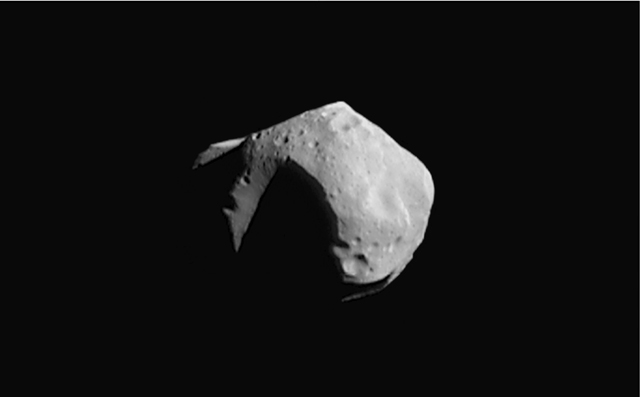
Spectral characteristics
A-type spectra show a strong, broad absorption band centered near 1 µm associated with olivine and a steeply reddened slope at wavelengths shortward of about 0.7 µm. In classification schemes they are distinct from S-type asteroids (which show mixed olivine and pyroxene features) and from V-type basaltic asteroids (which are pyroxene-dominated). Observational work and spectral surveys have been used to identify candidate A-types by these diagnostic features.
Composition and origin
The dominant mineral on A-type surfaces is olivine, a magnesium‑iron silicate whose signature appears as the 1 µm olivine band. Because olivine is abundant in rocky mantles, A-types are widely interpreted as fragments of a differentiated parent body's mantle produced when a larger asteroid experienced melting, core formation, and then was disrupted by a collision. This connection links A-types to broader questions about how many early asteroids underwent internal melting and differentiation.
Distribution and rarity
A-type asteroids are rare compared with more common types like C- and S-types. As an indication of their scarcity, only a few dozen had been securely identified in spectral catalogs through the early 21st century; for example, only 17 had been reported by 2005. Known examples tend to be isolated and scattered rather than concentrated in a single family, consistent with their origin as fragments from multiple disrupted parent bodies.
Scientific importance and distinctions
- Evidence of differentiation: A-types provide direct surface evidence for mantle material and for melting in small bodies.
- Comparative spectroscopy: Differentiating A-type spectra from S-, V-, and R-type spectra helps reconstruct parent-body compositions and collisional histories.
- Exploration targets: Their unique chemistry and rarity make some A-types attractive targets for spacecraft study and sample return missions.
Notable facts
Because olivine-rich meteorites are uncommon in meteorite collections, A-type asteroids help close gaps between remote observations and physical samples. Studies that combine visible and near-infrared spectroscopy, laboratory mineral spectra, and dynamical modeling continue to refine how many mantle fragments survive and where they are found in the inner Solar System. For further reading on spectral features and classification see olivine-focused resources and survey summaries.
Tags
Related articles
Author
AlegsaOnline.com A-type asteroid Leandro Alegsa
URL: https://en.alegsaonline.com/art/132