
Boomerang
A boomerang is a curved throwing implement that, when designed and thrown correctly, flies a curved path and often returns; used historically for hunting, sport and ceremony across many cultures.
Overview
A boomerang is a thrown object whose characteristic behaviour is a controlled, curved flight. Many people think of returning boomerangs that, when thrown with the correct spin and angle, fly in a loop and return to the thrower. Others are non-returning throwing sticks made to travel straight and strike targets at a distance. Boomerangs have served practical, recreational and ceremonial roles in different societies.
Image gallery
10 Images
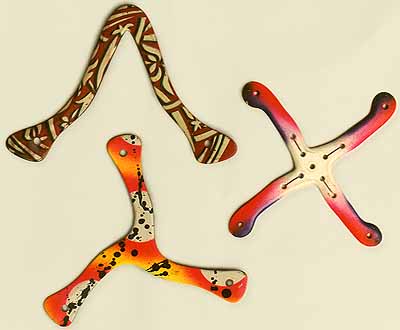


Aerodynamics and flight
Returning boomerangs normally have two or more airfoil-shaped arms joined at an angle. As the boomerang spins, each arm produces lift; because the arms move at different speeds relative to the air, lift is asymmetric. The combination of spinning motion and asymmetric lift produces gyroscopic precession, which gradually turns the boomerang’s plane of rotation and guides it into a curved trajectory. Throw angle, spin rate, tilt, wind and design all affect the flight path.
Types and construction
There are two broad categories: returning boomerangs used for sport, demonstration and recreation, and non-returning throwing sticks or hunting boomerangs designed to fly straight. Traditional boomerangs were carved from solid wood; modern examples use laminated wood, plywood, plastics, composites and carbon-fibre to improve strength, consistency and aerodynamics. Designs range from simple two-arm shapes to complex multi-wing aerobatic models.
History and cultural roles
Curved throwing sticks have been used for thousands of years. Aboriginal Australians developed many forms for hunting and ceremony, and boomerangs often carry cultural decoration and significance. Similar implements appear in other regions in the archaeological record. In many cultures these objects are both tools and symbols embedded in storytelling and ritual.
Throwing, sport and safety
To throw a returning boomerang, grip a tip, impart a firm spin and release with a slight tilt toward the wind. Boomerangs are used in recreational play and organized competitions that judge distance, accuracy and catches. Because they are fast-moving solid objects, safe open areas, awareness of bystanders and appropriate precautions are important.
Notable points
- Handedness: Boomerangs are made for right- or left-handed throwers and the shape matters for correct flight.
- Variety: Modern sport models permit precise tuning of flight characteristics.
- Cultural value: Traditional pieces often carry artistic designs and social meaning beyond their practical use.
Related articles
Author
AlegsaOnline.com Boomerang Leandro Alegsa
URL: https://en.alegsaonline.com/art/13026