
Ratnasiri Wickremanayake
Sri Lankan politician (1933–2016), two-time Prime Minister, senior SLFP leader and long-serving parliamentarian who led governments during pivotal years including the final phase of the civil war.
Ratnasiri Wickremanayake (born 5 May 1933, died 27 December 2016) was a Sri Lankan statesman known for a long career in national politics. His name in local languages is recorded in Sinhala as රත්නසිරි වික්රමනායක and in Tamil as ரத்னசிறி விக்க்றேமனயகே. Over several decades he served in parliament and in a number of cabinet-level roles.
Image gallery
1 Image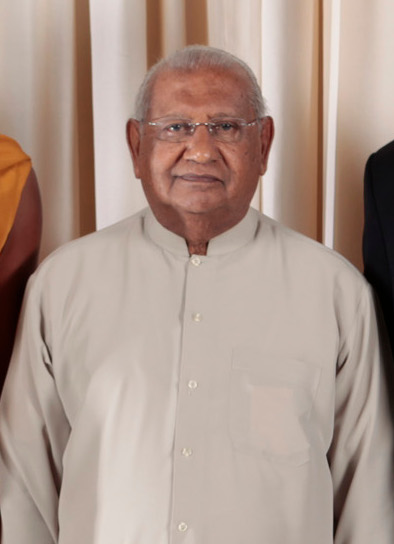
Political career and offices
Wickremanayake was a senior figure in the Sri Lanka Freedom Party (SLFP) and served twice as Prime Minister of Sri Lanka. His first premiership ran from 2000 to 2001 after the resignation of his predecessor, and he returned to the office for a longer period from 2005 to 2010. He also held leadership positions within his party and was considered one of its veteran operatives.
Background and rise
Originally active in provincial and national politics, Wickremanayake progressed through parliamentary ranks to become a cabinet minister and party deputy. He became prime minister in 2000 following the resignation of Sirimavo Bandaranaike, a major figure in Sri Lankan political life, and continued to be influential in successive SLFP-led administrations.
Context and responsibilities
His second tenure as prime minister coincided with a critical period in Sri Lanka's recent history, including the late stages of the civil conflict and subsequent reconstruction efforts. As prime minister he worked alongside the president and cabinet on national security, economic policy and post-conflict rehabilitation. Observers note that his role reflected both party priorities and the broader executive agenda of the government of the day.
Notable positions
- Prime Minister of Sri Lanka (2000–2001; 2005–2010) — office
- Senior vice-president and long-time leader within the Sri Lanka Freedom Party — SLFP
- Member of Parliament, including National List appointments and constituency service — Parliament
Wickremanayake's political life spanned decades of change in Sri Lanka. His supporters remember him as a steady party loyalist and experienced administrator; critics questioned some policy choices made during turbulent years. He died in late 2016, leaving a legacy tied to the SLFP's role in early 21st-century Sri Lankan governance.
Author
AlegsaOnline.com Ratnasiri Wickremanayake Leandro Alegsa
URL: https://en.alegsaonline.com/art/129274