
Ninian Stephen
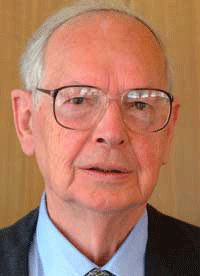
Sir Ninian Stephen (1923–2017) was an Australian jurist, public servant and the nation’s 20th Governor‑General. He served on the High Court and later represented the Crown while remaining active in public life.
Overview
Sir Ninian Martin Stephen (15 June 1923 – 29 October 2017) was an Australian jurist, civil servant and public official who held two of the country’s highest offices. He is best known for his service as a Justice of the High Court of Australia and later as the 20th Governor‑General of Australia. His career combined legal reasoning, ceremonial duties and involvement in national affairs, and he remained a respected public figure until his death in Melbourne in 2017.
Image gallery
2 Images
Legal career and High Court
Stephen’s professional life was anchored in the law. As a senior judge he participated in the highest level of appellate decision‑making in Australia, where justices interpret the Constitution and settle disputes of federal law. The work of a High Court Justice involves written opinions, hearings on points of significant principle and the responsibility to shape precedent that guides courts, governments and citizens.
Role as Governor‑General
In his later public service he took on the viceregal office, acting as the Crown’s representative in Australia. The Governor‑General’s duties are a mix of constitutional, ceremonial and community functions: giving royal assent to legislation, commissioning governments, presiding at formal ceremonies and supporting charitable, educational and cultural initiatives. Occupants of the post often seek to balance impartial constitutional practice with visible engagement across the community.
Contributions and public profile
Stephen’s reputation rested on professionalism, a careful legal mind and a measured approach to public duties. Beyond courtroom decisions and viceregal ceremonies, senior figures like him commonly engage in advocacy for civic causes, advise on legal and constitutional questions, and represent national interests in formal and informal settings. He was widely regarded as a dignified and steady presence in public life.
Notable facts and legacy
- He carried the title "Sir", reflecting national honours conferred in recognition of service.
- His two chief roles—High Court Justice and Governor‑General—placed him at the intersection of law and state, a path followed by relatively few Australians.
- Obituaries and remembrances emphasized his long public service and his contributions to Australia’s legal and civic institutions.
Stephen’s life illustrates how legal expertise and public service can combine in careers that influence both jurisprudence and national ceremonial life. For readers seeking more detail on specific rulings, speeches or honours, archival materials and official records provide primary-source accounts of his work and decisions.
Author
AlegsaOnline.com Ninian Stephen Leandro Alegsa
URL: https://en.alegsaonline.com/art/127703