
Mikhail Nesterov: Russian Symbolist and Painter of Sacred Themes
Overview of Mikhail Nesterov (1862–1942), his life, style, major frescoes and paintings, role in Russian Symbolism, and his legacy in religious and portrait art.
Mikhail Vasilyevich Nesterov (May 31 [O.S. May 19] 1862 – 18 October 1942) was a Russian painter best known for lyrical, devout images that helped give shape to Russian religious symbolism. Born in Ufa and later active in Kiev, St. Petersburg and Moscow, he produced canvas paintings, monumental church frescoes and intimate portraits that combine devotional feeling with a strong sense of the Russian landscape and peasant life. His Russian name is often rendered in Cyrillic as Михаи́л Васи́льевич Не́стеров.
Image gallery
10 Images


Training and artistic orientation
Nesterov studied at the Imperial Academy of Arts under Pavel Tchistyakov, where he absorbed a classical discipline in draftsmanship and composition. He gravitated toward the Peredvizhniki (the Wanderers) and the broader currents of late 19th-century Russian painting, but his work moved beyond strictly realist narratives into a symbolic, spiritual register. His painting The Vision of the Youth Bartholomew (1890–91) is widely cited as a landmark that signaled a new interest in religious and mystical subjects in modern Russian visual culture.
Major works and commissions
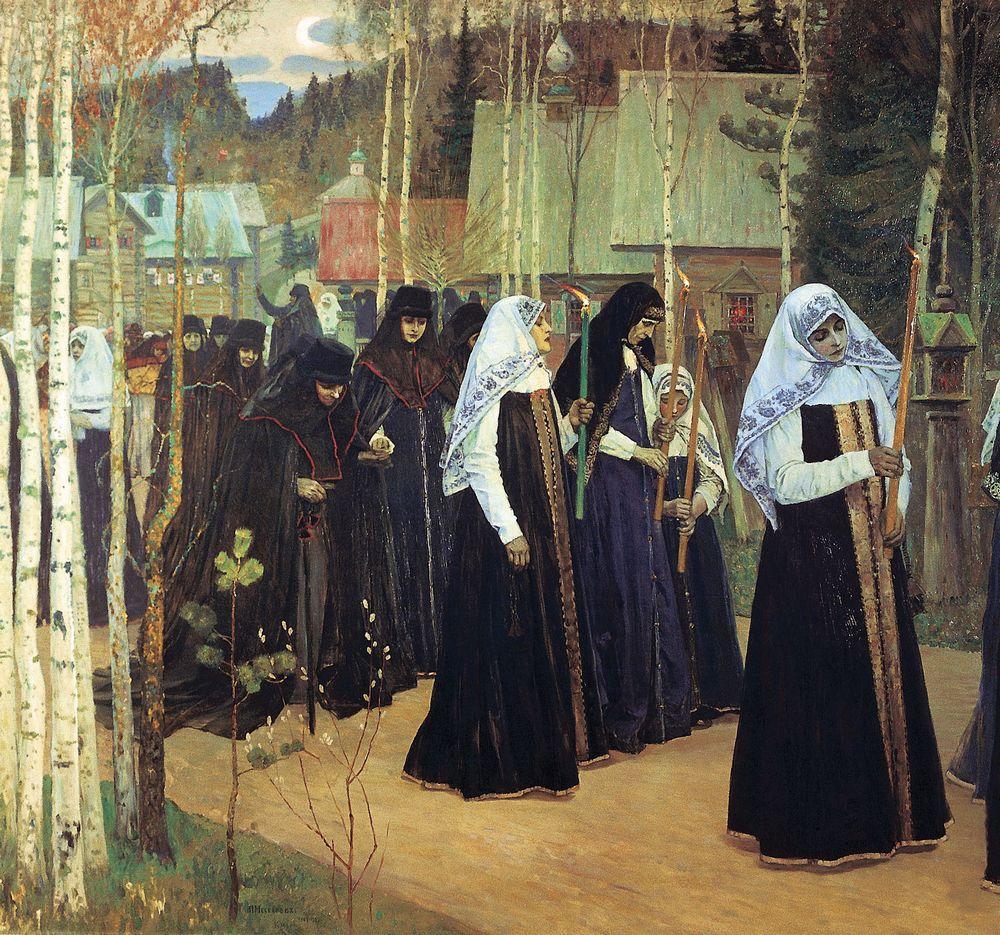
From the 1890s into the early 20th century Nesterov undertook large-scale ecclesiastical projects. He painted frescoes and iconographic programs for St. Vladimir's Cathedral in Kiev and contributed to the decoration of the Church of the Saviour on Spilled Blood in St. Petersburg. After 1910 he settled in Moscow and worked at the Marfo-Mariinsky Convent, producing devotional paintings and decorative schemes intended for worship and contemplation.
- The Vision of the Youth Bartholomew (1890–91) — conversion of the future Sergii of Radonezh
- Fresco program at St. Vladimir's Cathedral, Kiev — series of mural narratives
- Work on the Church of the Saviour on Spilled Blood, St. Petersburg — decorative panels and designs
- Portraits and smaller easel paintings produced in Moscow — public and private commissions
Style and themes
Nesterov's paintings are notable for a restrained palette, elongated figures fused with broad, simplified landscape forms, and a contemplative mood. He often depicted saints, monastics and rural inhabitants in quiet communion with nature, using light and sky as symbolic elements. His approach married Orthodox devotional traditions with the pictorial vocabulary of Symbolism, contributing to the development of a distinctly Russian spiritual modernism.
Later life and legacy
A devout Orthodox Christian, Nesterov declined to embrace the Bolshevik ideology but lived and worked in Soviet Russia until his death in Moscow. He continued to receive commissions and painted portraits of notable contemporaries, including intellectuals and scientists such as Ivan Pavlov, as well as figures from cultural and political life. His portraits also include images of Ivan Ilyin, Otto Schmidt and the sculptor Vera Mukhina. Nesterov's reputation rests on both his major mural cycles and his smaller devotional canvases; his work influenced later generations of Russian church painters and artists interested in spiritual themes within Russian art. Critics and historians often point to his synthesis of popular religious sentiment and modern pictorial means as a defining contribution to national culture (religious symbolism).
Today Nesterov's paintings and frescos are preserved in churches, museums and collections in Russia and abroad. His career illustrates the tensions of an artist committed to traditional faith and iconography while engaging with contemporary artistic movements, leaving a durable imprint on the way sacred subjects were treated in modern Russian painting.
Author
AlegsaOnline.com Mikhail Nesterov: Russian Symbolist and Painter of Sacred Themes Leandro Alegsa
URL: https://en.alegsaonline.com/art/127042