
Lyonel Feininger (1871–1956)
German-American painter and printmaker known for crystalline, architectural compositions, early cartoon work, and his teaching role at the Bauhaus; influential in Expressionist and modern print traditions.
Overview
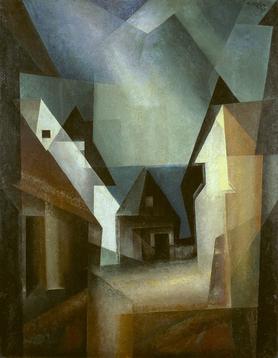
Lyonel Charles Feininger (July 17, 1871 – January 13, 1956) was a German-American artist whose work spans painting, printmaking and early comic-strip illustration. His mature paintings are noted for their prismatic, architectural forms and luminous, faceted surfaces that bridge elements of Expressionism and Cubism. Feininger is also remembered for his graphic work and for teaching at the influential German art school, the Bauhaus.
Image gallery
5 Images

Early career and cartoons
Feininger began his public artistic life as an illustrator and cartoonist. He produced sequential art for American newspapers and periodicals, gaining attention for inventive layouts and storytelling. This early experience in line, rhythm and narrative contributed to his later graphic clarity and compositional boldness in woodcuts and prints. For biographical details and reproductions of some cartoons see biographical sources.
Style, themes and media
Working in oils, watercolour and woodcut, Feininger developed a distinctive vocabulary of slender towers, steep-roofed towns, bridges and ships rendered with intersecting planes and crystalline light. Many works evoke cathedral spires and harbor skylines, combining architectural precision with lyrical atmosphere. His woodcuts and prints are notable for strong linear patterns and contrast, which helped revive interest in printmaking among modern artists.
Bauhaus and later life
Feininger became associated with the Bauhaus movement after World War I and served as a teacher there during the school's early years, influencing students through his emphasis on structure, rhythm and craft. Political developments in Germany in the 1930s disrupted many modern artists’ careers; Feininger returned to the United States where he continued to exhibit and produce work until his death. Museums and collections that hold his work include institutions listed at museum collections and galleries described at gallery resources.
Legacy and notable facts
- Feininger helped bridge commercial graphic practices and fine art, bringing narrative sense and compositional inventiveness to modernist painting.
- His woodcuts are studied for their technical clarity and striking use of black-and-white contrast.
- As a teacher at the Bauhaus he contributed to the school’s reputation for integrating craft, design and fine art.
Feininger's work remains widely exhibited and collected for its unique synthesis of geometrical order and poetic light. For overviews, exhibition histories and image galleries consult the links above.
Related articles
Author
AlegsaOnline.com Lyonel Feininger (1871–1956) Leandro Alegsa
URL: https://en.alegsaonline.com/art/125600