
List of rivers of Georgia (country)
Overview and guide to Georgia's principal rivers, their drainage basins, uses, historical importance and contemporary issues, with a list of notable waterways.
Georgia is traversed by numerous rivers that drain into the Black Sea to the west and into the Caspian Sea basin to the east. These waterways have shaped the country's landscapes, supported agriculture and cities, and provided routes for travel and trade since antiquity. Many Georgian rivers are mountainous and seasonal in flow, while a few larger arteries cross broad valleys and sustain irrigation and hydroelectric projects.
Image gallery
6 Images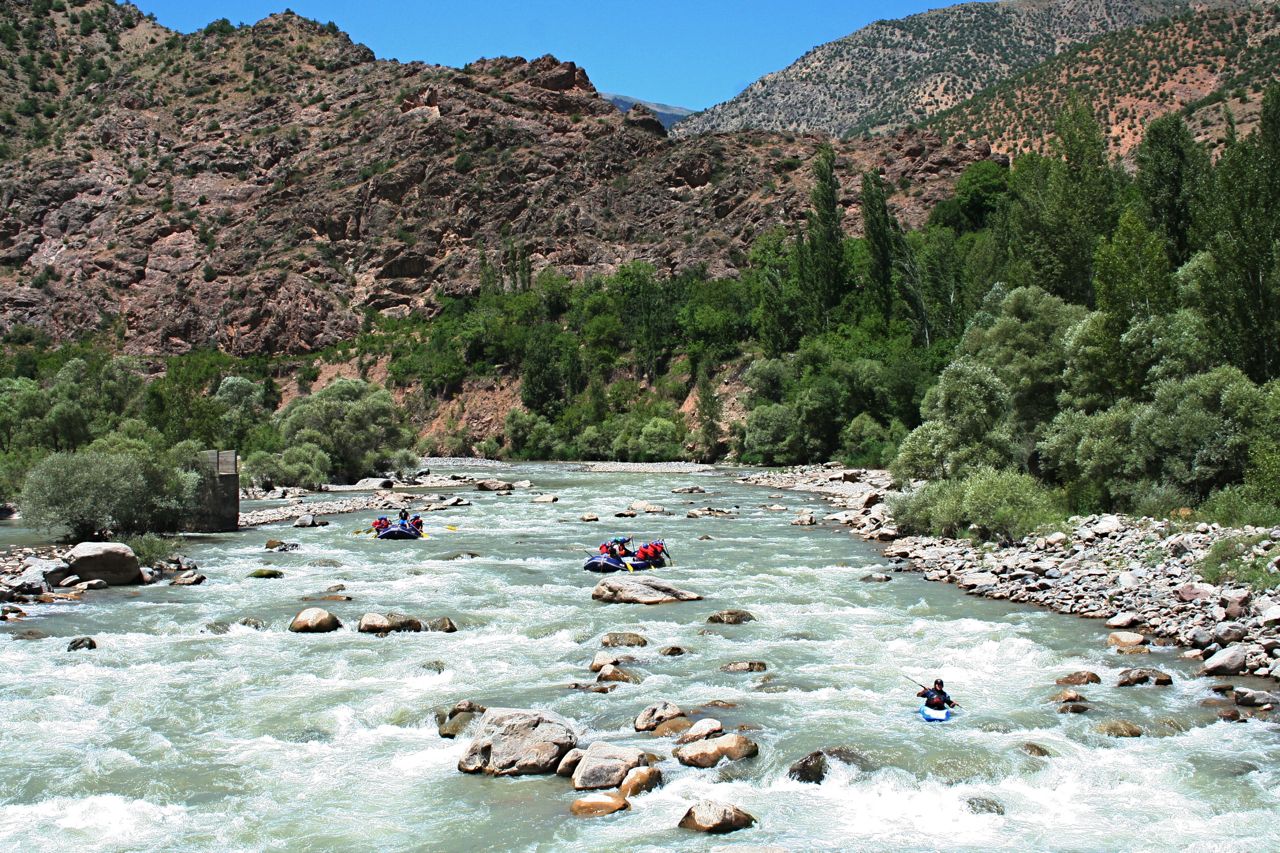



Major rivers
- Mtkvari (Kura) — the longest and most significant river in Georgia, flowing through Tbilisi and continuing east toward the Caspian basin.
- Rioni — the principal river of western Georgia, flowing westward to the Black Sea and passing near Kutaisi.
- Enguri — a western mountain river notable for the large hydroelectric complex and dam in its basin.
- Tergi (Terek) — rises in the Greater Caucasus and flows northward toward Russia and the Caspian region.
- Çoruh (Chorokhi) — runs in the southwest and continues into Turkey before reaching the Black Sea.
- Alazani — flows through eastern Kakheti and supports extensive vineyards and agriculture in its valley.
- Iori — an eastern Georgian river that feeds into the larger Caspian drainage system.
- Aragvi — a mountain river that joins the Mtkvari near the ancient capital region and is valued for tourism and local hydropower.
Rivers in Georgia are commonly used for irrigation, small- and large-scale hydropower, freshwater fisheries and recreation. Mountain streams supply mountain communities and also present opportunities for rafting and ecotourism. Navigation is limited to short stretches on larger lowland rivers rather than long-distance commercial shipping.
Historically, these rivers have defined settlement patterns and political boundaries. Cities such as Tbilisi and Kutaisi developed along river corridors that offered water, fertile soils and routes over the mountains. Several rivers also form or cross international borders, making their management a matter of transboundary cooperation.
Contemporary concerns include water quality degradation from urban and agricultural runoff, ecological impacts from dam construction and changing seasonal flows linked to climate variability. Restoration, watershed management and international agreements are part of ongoing efforts to balance development and conservation.
For maps, statistics and further reading, see additional resources on Georgia's rivers and hydrology.
Related articles
Author
AlegsaOnline.com List of rivers of Georgia (country) Leandro Alegsa
URL: https://en.alegsaonline.com/art/125005