
Blues scale: structure, history, and musical use
Overview of the blues scale: its interval structure, relation to the minor pentatonic and blue notes, history in African‑American music, common uses in blues and jazz, and typical variations.
Overview
The blues scale is a widely used melodic framework in blues, jazz, rock and other popular styles. It is commonly described as a six‑note (hexatonic) variant of the minor pentatonic scale with an added chromatic or flattened fifth degree, but that formula does not exhaust the variety heard in practice. Performers often treat certain scale degrees as "blue notes" that may be slightly lowered, bent or inflected in performance rather than played as fixed pitches. Because of this expressive flexibility, players and theorists sometimes emphasize function and feel over a single rigid fingering or pitch set.
Image gallery
2 Images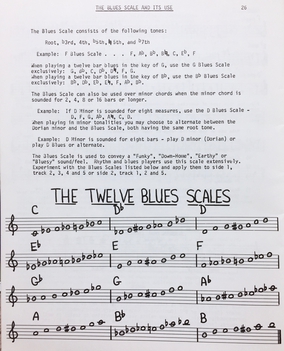

Structure and characteristic tones
One conventional theoretical form of the blues scale can be built by adding a diminished fifth (the so‑called blue note) to the minor pentatonic. In semitone steps that pattern is often given as 3–2–1–1–3–2 when measured around the octave. For example, a common C blues scale is: C–E♭–F–F♯(G♭)–G–B♭–C. Notation varies: the F♯ may be labeled as G♭ or described as a bent F moving toward G.
- Typical pitch content: tonic, minor third, fourth, augmented fourth/diminished fifth (blue note), fifth, minor seventh.
- Hexatonic: contains six distinct pitch classes within the octave.
- Expressive microtonality: blue notes are often approached by slides, bends or microtonal inflections rather than exact semitones.
History and development
The blues scale and the practice of blue notes emerged from African‑American musical traditions in the late 19th and early 20th centuries. Elements such as flattened thirds, fifths and sevenths, call‑and‑response patterns, and expressive pitch inflections have roots in West African musical aesthetics combined with work songs, spirituals and folk music of the United States. As the blues genre spread and interacted with jazz and popular music, the tonal palette of the blues scale became central to improvisation and song melodies.
Uses and examples
Players employ the blues scale as a compact source for soloing and riff construction because it supplies both the melodic color of minor third and minor seventh and the distinctive tension of the blue note. In blues contexts the scale commonly aligns with the key rather than a single chord, allowing melodic continuity across a 12‑bar progression. Jazz musicians also use the scale as one of several devices for building lines over dominant and modal harmony.
Variations and performance practice
There is no single definitive blues scale: different players and traditions emphasize different notes. Some versions omit the natural fifth or use the major third alongside the minor third for expressive contrast; others treat the blue note as a microtonal pitch between the fourth and fifth. Instructional sources may present a fixed six‑note pattern, but practical performance privileges bending, timing, and timbre. For further reading on expressive pitch inflection and notation, see resources that discuss blue notes and microtonality: blue notes explained.
Distinctions and notable facts
Important distinctions include the difference between the minor pentatonic and the blues scale (the latter normally adds the flattened fifth) and the distinction between theoretical scale steps and how they are actually realized in performance. In jazz pedagogy the blues scale is often taught as a key‑centered improvisational tool rather than a chord‑specific device; this point is discussed in various introductions to jazz theory and improvisation resources. Ultimately, the blues scale is as much a set of expressive practices as a list of pitches: its identity depends on sound, gesture and context as much as on notation.
Related articles
Author
AlegsaOnline.com Blues scale: structure, history, and musical use Leandro Alegsa
URL: https://en.alegsaonline.com/art/12406