
Bertolt Brecht
German playwright, poet and theatre theorist (1898–1956) who pioneered epic theatre and the Verfremdungseffekt; influential for political drama, song-integration, and the Berliner Ensemble.

Image gallery
7 Images



Early life and development
Born in Augsburg, Brecht trained briefly in medicine before turning to writing and the stage. His early experiences in World War I, and his reading of Marxist thought, informed an outlook that viewed theatre as a tool for civic debate. During the 1920s and early 1930s he produced plays, poems and theoretical essays that gradually articulated what became known as "epic theatre."

Artistic characteristics and methods
Brecht's theatre emphasizes the Verfremdungseffekt, often translated as "alienation" or "distancing" effect, which interrupts emotional identification and highlights theatricality. Techniques include direct address to the audience, visible stagecraft, placards or projections summarizing action, episodic structure, and songs that comment on or contradict the drama. These devices aim to make spectators active analysts of events on stage.
Major works and collaborations
He wrote both dramatic works and theoretical texts. His most widely performed plays blend social critique with innovative form. Brecht collaborated with composers such as Kurt Weill and Hanns Eisler and with actors and directors who helped realize his methods in performance.
- The Threepenny Opera (with Kurt Weill)
- Mother Courage and Her Children
- The Life of Galileo
- The Good Person of Szechwan
Exile, return and the Berliner Ensemble
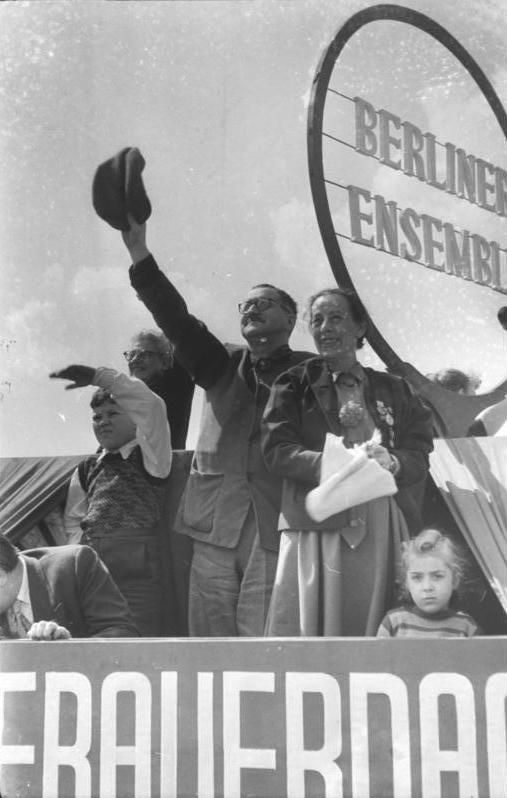
With the rise of Nazism Brecht left Germany and spent years in exile in Europe and the United States, where his political views made his position controversial. After World War II he returned to Germany and, based in Berlin, established the Berliner Ensemble with his wife, the actress Helene Weigel. The company became central to performances of his later plays and to spreading his theatrical ideas.
Influence and legacy
Brecht's combination of theory and practice influenced playwrights, directors and political theatre worldwide. His insistence that theatre could be a forum for social critique helped shape documentary, agitprop and avant-garde movements. Today his plays remain regularly staged and studied both for their political content and for their formal innovations that continue to challenge and inspire theatre-makers and audiences.
Questions and answers
Q: Who was Bertolt Brecht?
A: Bertolt Brecht was a German poet and dramatist.
Q: When was he born?
A: He was born on February 10, 1898 in Augsburg.
Q: What is his full name?
A: His full name is Eugen Berthold Friedrich Brecht.
Q: Where did he live?
A: He lived in Berlin.
Q: When did he die?
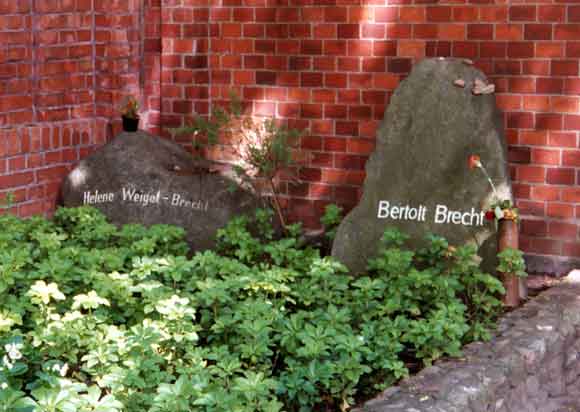
A: He died on August 14, 1956 in Berlin.
Q: What nationality was he?
A: He was German.
Q: How old was he when he passed away?
A: He was 58 years old when he passed away.
Related articles
Author
AlegsaOnline.com Bertolt Brecht Leandro Alegsa
URL: https://en.alegsaonline.com/art/115076