
Bikont — eukaryotes ancestrally bearing two flagella
Bikont: a proposed major eukaryotic grouping whose members ancestrally have two flagella. Covers defining traits, representative lineages, evolutionary evidence, and classification debates.
Overview
A bikont (from Greek: "two flagellae") is any eukaryotic organism placed in the proposed clade Bikonta. The name refers to an ancestral condition in which cells carry two flagella. The term is used by biologists studying deep eukaryotic relationships to distinguish this assemblage from the Unikonta (lineages historically thought to have one flagellum).
Image gallery
1 Image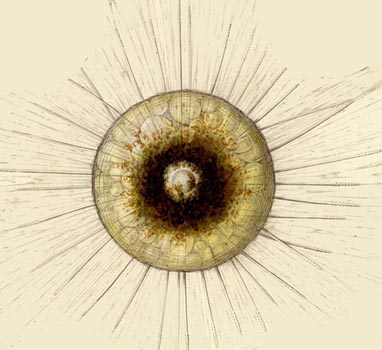
Key characteristics
Members of the Bikonta are diverse, ranging from single‑celled protists to multicellular algae and plants. Features often cited for the group include:
- Two anterior flagella in many flagellated representatives, often rooted in paired basal bodies.
- Shared molecular markers, such as certain gene fusions and sequence similarities, that suggest common ancestry.
- Cellular and cytoskeletal traits in flagellate forms that recur across lineages.
Evolutionary history and evidence
The Bikonta hypothesis arose from analyses of ribosomal RNA and multi‑gene datasets that grouped several major eukaryotic lineages together. Molecular features, including fused genes present across those lineages, provided additional support. However, deep branches of the eukaryotic tree are difficult to resolve and remain subject to new data and methods.
Diversity and examples
Lineages commonly associated with Bikonta include photosynthetic groups (for example, plants and many algae), and numerous protist clades. Because the grouping spans organisms with very different lifestyles and body plans, its members are important for studies of ecology, primary production, and the evolution of cellular complexity.
Distinctions and ongoing debate
While the two‑flagella ancestry is a simple character, classification at this depth relies heavily on molecular evidence and interpretation. Some analyses uphold Bikonta as a useful division; others recover alternative arrangements. Readers seeking more detail on current phylogenetic studies can consult specialist summaries and reviews here.
Notable point: the term "bikont" denotes a proposed evolutionary grouping, not a single diagnostic trait present in all living members today; many descendants have lost or modified flagella during evolution.
Related articles
Author
AlegsaOnline.com Bikont — eukaryotes ancestrally bearing two flagella Leandro Alegsa
URL: https://en.alegsaonline.com/art/11415
Sources
- mbe.oxfordjournals.org : "Monophyly of Rhizaria and multigene phylogeny of unicellular bikonts"
- doi.org : 10.1093/molbev/msl055
- pubmed.ncbi.nlm.nih.gov : 16829542
- doi.org : 10.1078/0932-4739-00002