
7th century (601–700)
The 7th century (601–700) saw dramatic political, religious and cultural change: the emergence of Islam, the collapse of the Sasanian state, Tang consolidation in China, and shifting powers across Eurasia.
Overview
The 7th century covered the years 601 to 700. It is remembered as a transitional era that reshaped large parts of Eurasia and beyond. Long-standing empires confronted internal strain and external challengers while new religions and polities emerged, altering trade, administration and cultural life.
Image gallery
7 Images



Politics and warfare
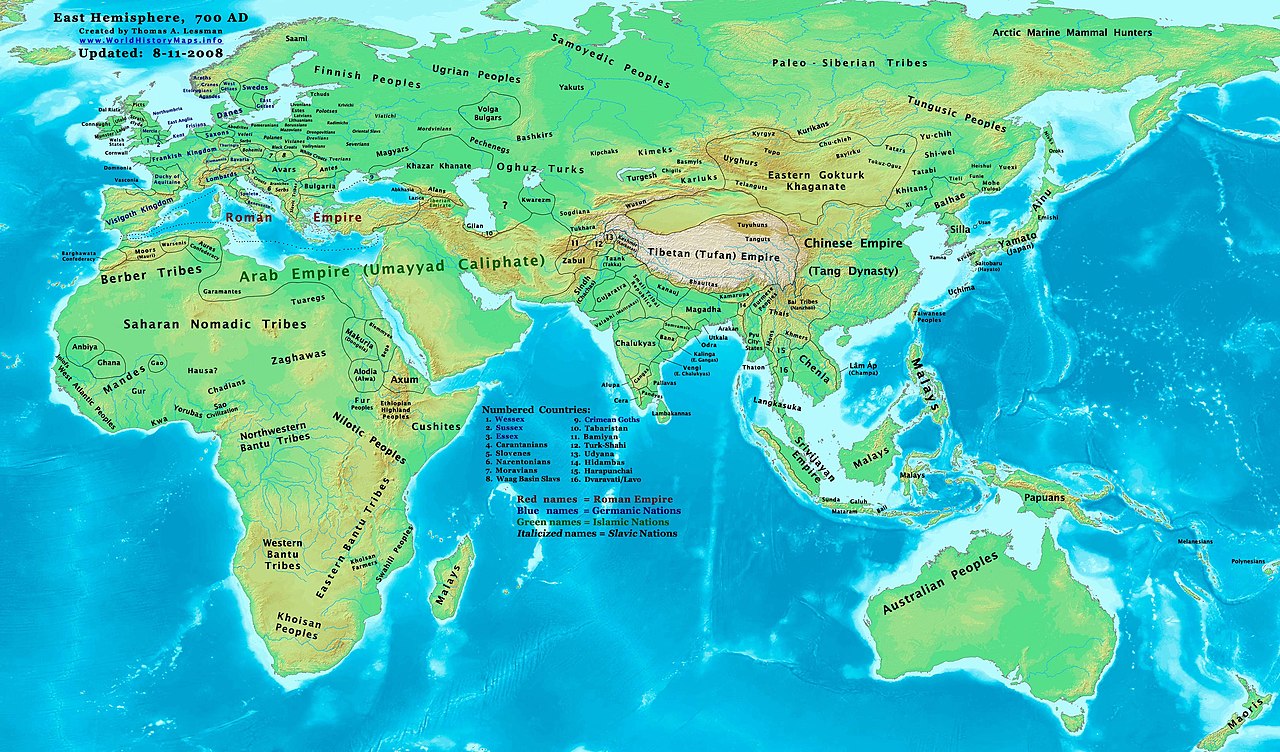
This century witnessed the final Byzantine–Sasanian conflicts and the disappearance of the Sasanian Empire. In the Arabian Peninsula the lifetime of the Prophet Muhammad and the rapid expansion of early Islamic polities produced the Rashidun and then the Umayyad caliphates. Byzantine recovery under Emperor Heraclius and later shifts in frontier control created a new political map from North Africa to Central Asia.
East Asia and the Korean–Japanese realms
In East Asia the short-lived Sui dynasty was replaced by the Tang dynasty, whose institutions and culture consolidated Chinese influence. On the Korean peninsula, Silla united much of the region with Tang support, and in Japan the Asuka period and the Taika reforms advanced centralized government models and the spread of Buddhism.
Religion, society and culture
The 7th century is crucial for the spread of major world religions. Islam became a state religion and a vehicle for Arabic language and administration. Buddhism continued to spread and adapt across East Asia. In Western Europe, monasticism preserved learning; the Synod of Whitby and other synods shaped Christian practice in the British Isles.
Notable developments
- Rapid Islamic conquests and formation of caliphal rule.
- Fall of the Sasanian Empire and territorial realignment in the Near East.
- Foundation and consolidation of the Tang dynasty in China.
- Political fragmentation and religious consolidation in early medieval Europe.
- Continued cultural florescence in regions such as the Classic Maya area.
Overall, the 7th century set patterns — administrative, religious and linguistic — that shaped the medieval world and influenced subsequent centuries across multiple continents.
Related articles
Author
AlegsaOnline.com 7th century (601–700) Leandro Alegsa
URL: https://en.alegsaonline.com/art/113059