
42 — the fictional 'Answer to the Ultimate Question' and its cultural legacy
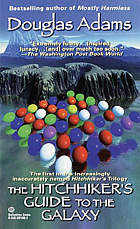
The number 42, made famous by Douglas Adams' The Hitchhiker's Guide to the Galaxy, is presented as the Answer to the Ultimate Question of Life, the Universe, and Everything and has become a widespread cultural symbol.
In Douglas Adams' comic science-fiction series The Hitchhiker's Guide to the Galaxy, the integer 42 is revealed to be the "Answer to the Ultimate Question of Life, the Universe, and Everything." In the story, a supercomputer named Deep Thought takes seven and a half million years to compute this answer. The result is presented as plain and inexplicable: 42, without the accompanying Ultimate Question that would make the answer meaningful.
Image gallery
5 Images


Literary context and fictional role
Within the narrative, the discovery that "42" is the answer generates more confusion than relief. Deep Thought explains it cannot supply the Ultimate Question itself, only the answer; it then designs an even larger, more elaborate computer to determine the question. That second device is presented as a living, planet-sized computation—Earth—whose biosphere and inhabitants are integral to the calculation and are expected to run for a multi-million-year cycle to yield the missing question. This conceit blends philosophical satire with absurdist humour: a simple numeral stands in for meaning that cannot be recovered by brute force computation alone.
Authorial intent and explanation
Douglas Adams later stated that he selected the number deliberately for its ordinariness and comic effect rather than because of any hidden metaphysical significance. Adams described the choice as arbitrary and intended to be amusingly anticlimactic; the mundane quality of 42 plays into the book's satire of grand searching for meaning. Over time, that intentional mundanity became part of the joke, prompting fans to seek patterns and deeper reasons where the author insisted none were intended.
Cultural impact, references and examples
Since the book's publication, 42 has entered popular culture as a shorthand for an enigmatic or definitive answer and as a nod to science-fiction fandom. It appears as an Easter egg in software, films, television shows and public art, and is used by scientists, programmers and writers as an in-joke. A few commonly noted real-world coincidences and resonances include:
- In the ASCII character set, the decimal value 42 corresponds to the asterisk (*) character, often used as a wildcard or placeholder.
- M42 is the catalogue designation for the Orion Nebula (Messier 42), a bright and well-known astronomical object, a coincidence often pointed out by enthusiasts.
- Fans and creators have embedded the number into software version numbers, product model names and pop-culture references to signal homage to Adams' work.
Reception, interpretations and legacy
Scholars and readers sometimes treat 42 as a lens for exploring themes in Adams' work: absurdism, the limits of computational answers, and the human tendency to seek simple conclusions to complex questions. Others embrace the number as a playful cultural token. Attempts to identify a deeper mathematical, mystical or scientific meaning for 42 have produced many entertaining but mostly speculative claims; the author’s own account remains the authoritative explanation.
Further reading and related topics
The story of 42 connects to broader discussions about meaning, randomness and the role of computation in philosophical inquiry. To learn more about the fictional context, consult resources on The Hitchhiker's Guide to the Galaxy, and for the planet-as-computer concept see general treatments of artificial minds and thought experiments in philosophy of mind. For background on the real planet invoked in the narrative, see entries about Earth.
Related articles
Author
AlegsaOnline.com 42 — the fictional 'Answer to the Ultimate Question' and its cultural legacy Leandro Alegsa
URL: https://en.alegsaonline.com/art/112896