
Bloodborne (video game)
Bloodborne is an action role-playing game by FromSoftware, directed by Hidetaka Miyazaki. Noted for fast, aggressive combat, Gothic-horror setting, and high difficulty, it introduced distinct mechanics to the studio's formula.
Overview
Bloodborne is an action role-playing game developed by FromSoftware and directed by Hidetaka Miyazaki. First released for a single home console, it is widely recognized for refining the studio's established formula with a faster, more offensive combat style and a dark, Gothic-horror aesthetic. Players control a customizable Hunter who explores the decrepit city of Yharnam and its surrounding areas, uncovering a story told mostly through environment, item descriptions, and cryptic dialogue.
Image gallery
3 Images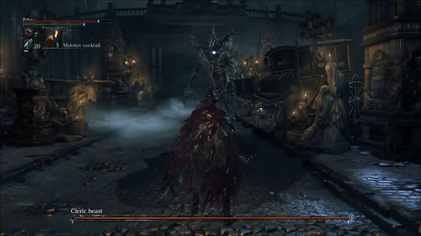


Gameplay and mechanics
Combat in Bloodborne emphasizes aggression and timing. Melee weapons frequently transform between two forms, providing different reach and attack patterns, while firearms are used primarily to interrupt and stagger enemies rather than deal high damage. A distinctive "rally" or regain mechanic allows players to recover a portion of recently lost health by striking back at foes for a short time after being hit. Healing is managed through consumable blood vials rather than stamina-locked potions.
Many staples of FromSoftware's earlier titles are present but altered: enemies and bosses remain formidable, death carries a penalty by dropping accumulated experience (known in the game as Blood Echoes) at the point of death, and exploration rewards careful observation and adaptation. Multiplayer includes cooperative summoning and asynchronous interactions. Players can also undertake optional, randomly generated chalice dungeons that provide additional challenge and loot.
Similarities and differences with the Souls line
- Similarities: high challenge, checkpoint systems, loss-and-recovery of experience, weapon upgrades, and a focus on player skill and pattern recognition.
- Differences: a faster, hit-and-run combat philosophy; use of firearms for parrying; reduced emphasis on heavy armor; weapon transformation and fewer conventional shields; and a stronger thematic focus on cosmic horror and contagion rather than medieval fantasy.
Setting, themes, and narrative
Bloodborne's world draws on Victorian architecture, Gothic atmosphere, and cosmic-horror influences. The city of Yharnam is afflicted by a mysterious scourge that turns citizens into beasts, and the narrative explores themes of knowledge, obsession, and the limits of human understanding. Much of the plot is deliberately opaque: clues are scattered through item text, environmental detail, and optional dialogues, inviting players to piece together multiple interpretations.
Development, release, and reception
Developed by FromSoftware with Hidetaka Miyazaki at the helm, Bloodborne was praised for its design, atmosphere, and combat innovations while also noted for its punishing difficulty. Additional content in the form of a substantial expansion added new bosses, areas, and story elements. Critics and players often highlight the game's cohesive aesthetic, sound design, and level architecture as high points.
Legacy and influence
Bloodborne influenced subsequent action games that favor faster, more aggressive melee design and has maintained a dedicated community of players, speedrunners, and analysts. Its unique blend of Gothic horror and ambiguous storytelling has made it a frequent subject of video game studies and retrospectives. For further details on the developer and related titles, see the developer's page at FromSoftware, the director's profile at Hidetaka Miyazaki, and a general overview of the studio's franchise at the Souls series. Additional information on online features and multiplayer can be found at official resources, and notes on the experience system and loot mechanics are available at experience system references.
Questions and answers
Q: What is Bloodborne?
A: Bloodborne is an action RPG made by FromSoftware led by Hidetaka Miyazaki.
Q: What is similar between Bloodborne and the Souls series?
A: Both games have a high level of difficulty, enemies and bosses can kill the player in only a few hits, experience points are earned by killing enemies, and upgradeable weapons and armor can be found or bought.
Q: How are experience points obtained in Bloodborne?
A: Experience points are earned by killing enemies, dropped if the player dies, and disappear forever if the player dies again before getting them back.
Q: What is important for dodging enemy attacks in Bloodborne?
A: Rolling is important for dodging enemy attacks in Bloodborne.
Q: What are the differences between Bloodborne and the Souls series?
A: While Bloodborne has many similarities with the Souls series, there are also some big differences as well.
Q: Are the difficulty levels in Bloodborne and the Souls series adjustable?
A: No, the difficulty levels in Bloodborne and the Souls series cannot be changed.
Q: Where can upgradeable weapons and armor be found in Bloodborne?
A: Upgradeable weapons and armor can be found in the game world or bought using experience points in Bloodborne.
Related articles
Author
AlegsaOnline.com Bloodborne (video game) Leandro Alegsa
URL: https://en.alegsaonline.com/art/115326