
Béziers: historic city and wine-producing center in southern France
Béziers is an ancient subprefectural town in Hérault, Occitanie, known for its medieval centre, Cathédrale Saint‑Nazaire, Canal du Midi nearby, vineyards and the popular Feria bullfighting festival.
Occitan: Besièrs — Béziers is a long-established town in the Languedoc area of modern southern France. It is administratively a commune, serves as a subprefecture and is the capital of its arrondissement. The town lies in the Hérault department (a département) within the wider Occitanie region, on the plain north of the Mediterranean coast of southern France. The historic centre perches on a bluff above the Orb River and retains a compact medieval layout with narrow streets, churches and ramparts.
Image gallery
10 Images




Geography and setting
Béziers occupies a strategic position where ancient roads and rivers met. The town overlooks extensive vineyards across a fertile plain and lies close to the Canal du Midi, the 17th‑century waterway that linked the Atlantic and Mediterranean coasts and today provides boating and cycle routes for visitors. The climate is Mediterranean, with warm summers and mild winters, favourable to viticulture that has shaped the local economy for centuries.
History and origins
Archaeological evidence indicates long human presence in the area. Some classical traditions and fieldwork suggest settlers from the Greek world were active on the Languedoc coast in the 6th century BCE; modern archaeologists continue to study the material record and the links between local sites and early Mediterranean trade. Those hypotheses have led some commentators to describe Béziers among the oldest continuously occupied towns in what is now France, alongside places such as Marseille, though precise comparisons remain debated. Béziers later developed under Roman influence and passed through Visigothic and medieval phases.
The medieval period includes a particularly grim episode: in 1209, during the Albigensian Crusade, the city suffered a massacre when crusading forces attacked as part of the suppression of the Cathar movement. This event left a lasting mark on local memory and historiography.
Economy, culture and events
The surrounding countryside is a significant wine-producing area; vineyards and associated trades have long shaped the economy. Contemporary Béziers combines agriculture with light industry, services and tourism. Cultural life features museums, weekly markets, and annual festivities. The Feria de Béziers, a popular late-summer event rooted in bullfighting traditions and popular celebrations, attracts many visitors to the town.
Notable places
- Cathédrale Saint‑Nazaire: the Gothic cathedral stands dramatically on the cliff edge above the Orb, rebuilt over earlier foundations.
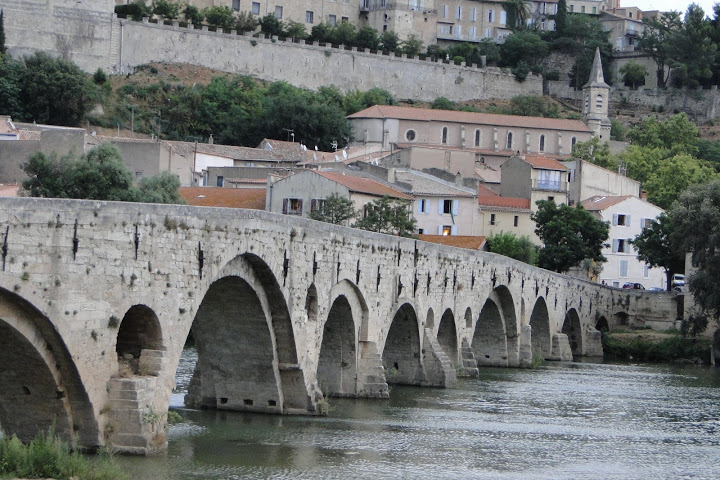
- Pont Vieux and riverfront: historic bridges and quays provide views of the valley and a sense of the town's riverine setting.
- Canal du Midi approaches: routes near Béziers offer boating, walking and cycling along a recognised historic waterway.
- Public gardens and boulevards: 19th‑century promenades and the Plateau des Poètes give open green space within the urban fabric.
- Local museums and archaeology: collections display Roman and medieval finds; ongoing work by classical scholars and field teams helps refine understanding of the town's early phases.
As a local administrative centre and cultural hub, Béziers attracts visitors interested in medieval streets, wine culture and regional festivals. Its long occupation, archaeological research and visible monuments make it a notable place for anyone studying the layered history of southern France.
Questions and answers
Q: What is Béziers?
A: Béziers is a commune in the Hérault département in the Occitanie region in southern France. It is a subprefecture of the department and also the capital of the arrondissement of the same name.
Q: What language do people speak in Béziers?
A: People in Béziers speak Occitan.
Q: When was Béziers built?
A: Research shows that Béziers was built by Greeks in the 6th century BC.
Q: Is it possible that Béziers could be older than Marseille?
A: Some archaeologists think that Béziers could be the oldest town of France, even before Marseille.
Q: Where is Béziers located?
A:Béziers is located in southern France, within the Occitanie region.
Q: What type of government does Bézier have?
A:Bézier has a subprefecture form of government, with its own arrondissement as well.
Q: How long has it been since humans first inhabited this area?
A:Research suggests that humans have inhabited this area for at least 2,600 years, since it was founded by Greeks in the 6th century BC.
Tags
Related articles
Author
AlegsaOnline.com Béziers: historic city and wine-producing center in southern France Leandro Alegsa
URL: https://en.alegsaonline.com/art/11155
Sources
- ville-beziers.fr : "Annuaire des élus"
- midilibre.fr : "Des révélations sur le passé grec de Béziers"
- lepoint.fr : "La plus vieille ville de France ?"
- annuaire-mairie.fr : "Ville de Béziers"
- habitants.fr : "Hérault"
- insee.fr : "Régions, départements, arrondissements, cantons et communes"
- insee.fr : "Unité urbaine de Béziers (34501)"
- insee.fr : "Aire urbaine de Béziers (053)"