
1431 (year and integer)
1431 is a year of the 15th century noted for the trial and execution of Joan of Arc and other events; as an integer it is composite, with prime factorization 3^3 × 53.
Overview
1431 refers to both the calendar year in the 15th century (AD/CE) and to the integer 1431. As a year it lies in the late Middle Ages, a period of dynastic conflict, religious councils and shifting political boundaries that preceded fuller Renaissance developments. As a number it is an odd composite integer with a simple prime factorization and routine arithmetical properties.
Image gallery
2 Images
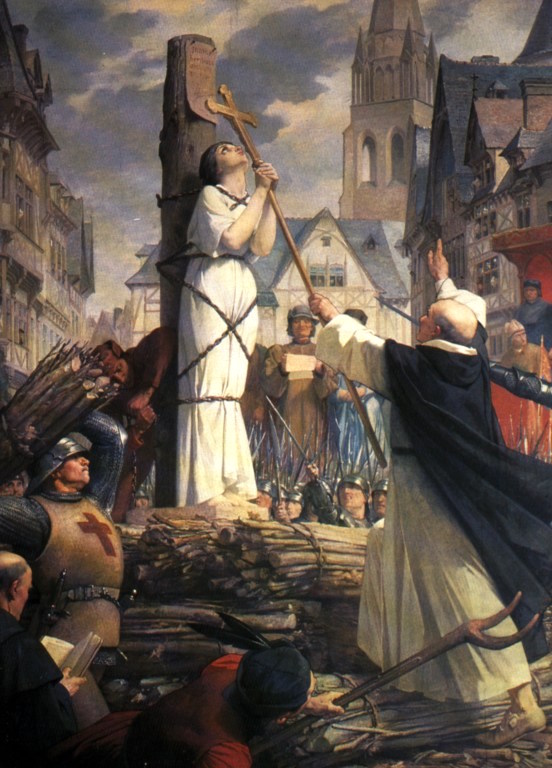
Notable historical events in the year 1431
- Joan of Arc: One of the most widely remembered events of 1431 is the trial and execution of Joan of Arc. Captured in 1430, she was tried by an ecclesiastical court and executed by burning in Rouen on 30 May 1431. Her death resonated through contemporary politics and has continued to shape national memory; she was posthumously retried and declared innocent in the 15th century and later canonized in the 20th century.
- Council of Basel: The Council of Basel, an important church council that addressed reform and disputes within Western Christendom, opened in 1431. The council would play a role in debates about church authority and relations with various reform movements.
- Henry VI in France: In 1431 Henry VI of England was crowned (in name) as king of France in Paris, a manifestation of English claims during the latter stages of the Hundred Years' War. The conflict between England and France continued to shape European affairs throughout the decade.
- Papal succession: The papacy saw transition in 1431; Pope Martin V died and was succeeded by Pope Eugene IV, a change that influenced papal policy and relations with secular rulers.
Context and legacy
Events of 1431 are often discussed in the context of the Hundred Years' War, internal church reform movements and the gradual political consolidation of European states. The trial of Joan of Arc became a focal point for later rehabilitation and veneration, altering historical interpretations of the period. The Council of Basel and papal succession contributed to church politics that affected councils, diplomacy and responses to regional dissent.
Mathematical properties of the integer 1431
The integer 1431 is composite. Its prime factorization is 1431 = 3^3 × 53, so its positive divisors are 1, 3, 9, 27, 53, 159, 477 and 1431. Because the sum of its decimal digits is 9, the number is divisible by 9. In common numeral systems it appears as binary 10110010111, octal 2627 and hexadecimal 0x597. These representations and factors are useful when 1431 appears as an identifier, catalogue number or in elementary number theory exercises.
Usage as a label and in chronology
As with other year numbers, 1431 serves both as a chronological label in historical writing and as a simple integer in mathematics, indexing and cataloguing. Writers commonly indicate the era (for example "1431 CE" or "AD 1431") when needed to avoid ambiguity. When treated as a year, 1431 is typically paired with events, biographies and diplomatic records from the early 15th century; when treated as a number, it is considered in the context of divisibility, factorization and numeral-system conversions.
Related articles
Author
AlegsaOnline.com 1431 (year and integer) Leandro Alegsa
URL: https://en.alegsaonline.com/art/111350